Reviews
Why I Rarely Review the Cigars I Love
By Eric Schleien·October 25, 2026
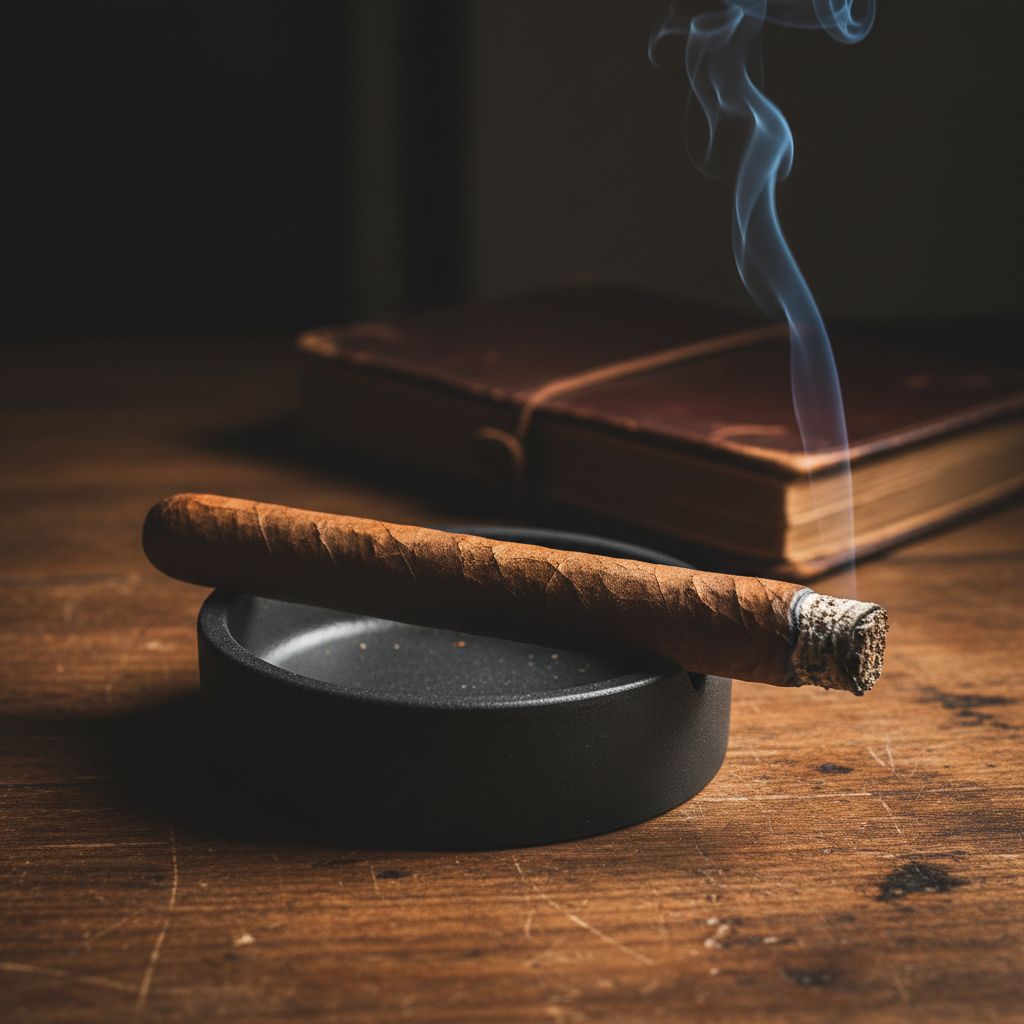
A friend once handed me a notebook bound in scarred calfskin, its pages ruled with tidy columns for ring gauge, draw resistance, combustion line, and tasting notes. He wanted me to catalog everything. At the time, I felt an obligation to dissect every stick that touched my palate—to measure the ash in centimeters and assign numerical grades to the quiet hours of my evening. I filled three pages. On the fourth, I stopped mid-sentence while smoking an aged Churchill rolled with vintage Jalapa binder and a dark, oily wrapper that tasted of unsweetened cocoa and damp earth. I realized that the moment I reached for the pen, the spell shattered.
The industry runs on evaluation. We are conditioned to treat tobacco as an exam, grading cigars on a hundred-point scale as though pleasure could be calibrated like an engine. Yet over the years running SmokeDaddy Cigar Company, I have found myself writing fewer and fewer formal reviews of the vitolas I hold dearest. The cigars that merely interest me—the ones that are technically competent, structurally flawed, or academically curious—are easy to dismantle. But the cigars I truly love demand silence, not critique.
To review a thing is to establish distance from it. You must hold the smoke in your mouth not merely to experience it, but to cross-examine it. You ask: Is that toasted almond or walnut? Is the finish medium or long? Is the mineral note a defect in the soil or an intentional counterpoint to the ligero? In that posture of clinical interrogation, intimacy evaporates. You become a magistrate presiding over an offering that was meant only to be consumed.
When a cigar is transcendent, it does not present itself as a checklist of isolated flavors. It arrives as an atmosphere. A great broadleaf robusto smoked at midnight on an empty porch does not need to be broken down into baking spice, leather, and molasses; it exists as a singular weight in the hand, a cadence of white smoke against cold cedar, a rhythm of thought slowed to the pace of glowing ash. To dissect it is to perform an autopsy on something that was meant to live only for an hour and a half.
There is also the matter of memory. Taste is notoriously unfaithful when stripped of its context. A stick rolled from double-fermented Habano leaves might taste magnificent because the humidity was precise and the fermentation was patient, yes, but also because you were sitting beside a river with someone you haven't seen in a decade. The spreadsheet ignores the river. It reduces the entire afternoon to a score. Whenever I attempt to write an exhaustive critique of a stick that moved me, the resulting prose feels dry, like pressed flowers that have lost their scent. The reviewer Eric Schleien might be able to tell you the leaf priming and the burn rate, but the smoker named Eric Schleien only remembers the stillness of the room.
At SmokeDaddy, clients sometimes ask why our private notes and internal reflections linger more on texture, temperature, and mood than on granular scorecards. It is because we believe the deepest appreciation of tobacco is an exercise in presence, not an audit. A cigar is an ephemeral art form. It cannot be preserved in a gallery, framed on a wall, or played back on vinyl. Its very medium is its own destruction. When you light the foot, you enter a contract with time: this seventy minutes will burn away, leave an inch of grey sediment in the porcelain tray, and vanish forever.
Why spend those seventy minutes as a court stenographer?
I still keep technical logs when blending, of course. When we test prototypes, the palate must be ruthless. We hunt for harshness in the throat, we track the tunneling of poorly bunched volado, we debate the proportion of San Andrés leaf required to tether a flighty Dominican filler. That is craft, and craft requires the scalpel.
But when the work is finished, and I pull an unbanded corona gorda from my personal humidor at the end of a long Tuesday, the critic leaves the room. The lighter clicks. The foot takes the flame. The room fills with the dry, leathery aroma of well-cured tobacco, and I let the pen lie cold on the desk. The greatest tribute you can pay to a master torcedor is not to assign him ninety-four points; it is to smoke his creation all the way down to the nub, entirely forgetting that you were supposed to be keeping score.
· ✦ ·