Pairings
The Virtue of Water
By Eric Schleien·June 26, 2026
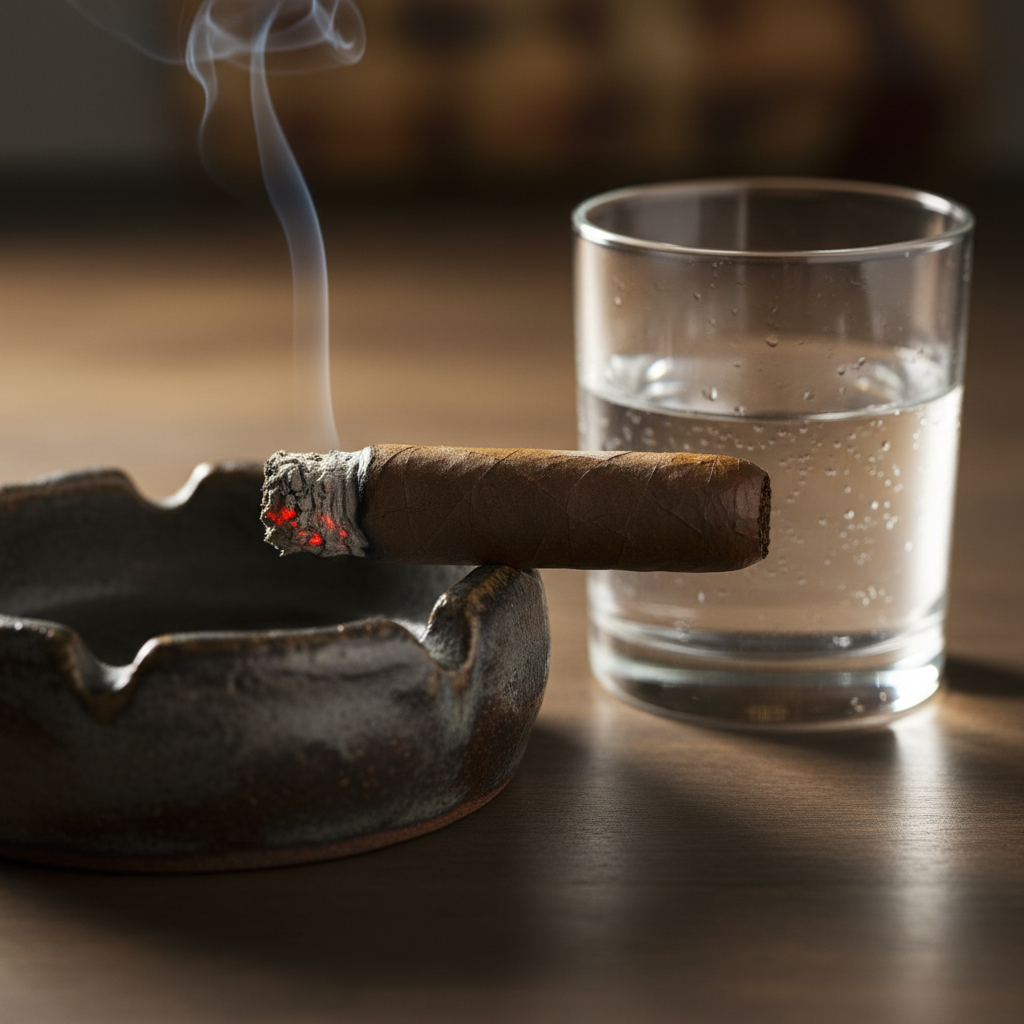
The tumbler sits on the table, clean and empty. A friend, settling into the chair across from me, has already poured himself two fingers of something dark and smoky from a squat bottle. It’s a familiar ritual, almost a reflex for many: the cigar is lit, the glass is filled. He raises his, an unspoken toast, and takes a sip before drawing on the pirámide he has just carefully torched.
I nod, but my own glass remains empty. It is not a judgment, merely an observation of a path I have diverged from over the years. My instinct, especially when a truly magnificent cigar is resting in my hand, is not to reach for a pairing, but to pull back from it. The better the cigar, the less I feel the need to amplify it with a spirit. In fact, I crave the opposite.
So much of our culture is about addition, about enhancement. We add a sauce, a filter, a soundtrack. In the world of cigars, this often translates to finding the perfect whisky, rum, or cognac to “complement” the smoke. I understand the impulse. A young, boisterous cigar full of sharp angles and raw power can indeed be tamed and rounded by a sweet spirit. A simple, one-dimensional smoke might be made more interesting by the spicy counterpoint of a rye whiskey. The drink becomes a crutch, a partner brought in to fill the quiet parts of the conversation.
But the great cigars, the ones I save for moments of quiet and reflection, are not conversationalists. They are orators. They are symphonies. They contain, within their tight, oily wrappers, a complete and self-contained world. The story is already there, written in the soil of Estelí, in the sun of the Jalapa valley, in the precise and patient hands of the roller. Why would I want to talk over it?
## The Palate’s Journey
A truly great cigar asks for your presence. It demands a level of attention that a high-proof spirit simply will not permit. The initial sips of a strong bourbon might seem to unlock new flavors, but it’s a fleeting illusion. What is really happening is that the alcohol is beginning to anesthetize the palate, to coat the tongue, to shout down the subtle and evolving notes of the tobacco. That fleeting note of cedar, the creamy texture of a well-aged Corojo wrapper, the mineral tang from volcanic soil, the slow build from sweet viso to the spicy tingle of ligero—these are the details that get blurred and eventually erased by the persistent presence of alcohol.
From my perch at SmokeDaddy, I see the full spectrum of smokers. I see the celebratory groups, glasses clinking. I also see the solitary smoker, lost in a cloud of thought, with nothing but a glass of water for company. This latter figure, I believe, is on to something profound. They are not merely smoking; they are listening.
My personal humidor is a library of these quiet stories. There are cigars in there that have been sleeping for five, sometimes ten years. When I finally choose one, the decision is deliberate. The ritual is not about what I will add to the experience, but what I can strip away. I want to remove distraction. My goal is to create a clean space, a clear signal, so that I can hear what the cigar has to say.
My companion of choice, then, becomes water. Simple, still water. Or perhaps a glass of sparkling water, its effervescence acting as a gentle reset for the palate between draws, scrubbing it clean and preparing it for the next nuance. A mild, un-sweetened coffee can serve a similar purpose in the afternoon. The function is not to add a new flavor, but to clarify the ones already present. It is an act of respect—for the leaf, for the blender, for the time I have set aside for this specific purpose.
It is not an indictment of pleasure. It is a refinement of it. It’s the quiet conclusion I’ve reached, the philosophy that I find myself returning to. This isn’t a rule for others, but simply an observation from Eric Schleien, a man who has found that the richest experiences often come not from adding more, but from being fully present with what is already there. The great cigar is enough. It is complete. The empty glass is not a lack; it is a sign of respect.
· ✦ ·