Craft
The Straight Path of the Burn
By Eric Schleien·August 2, 2026
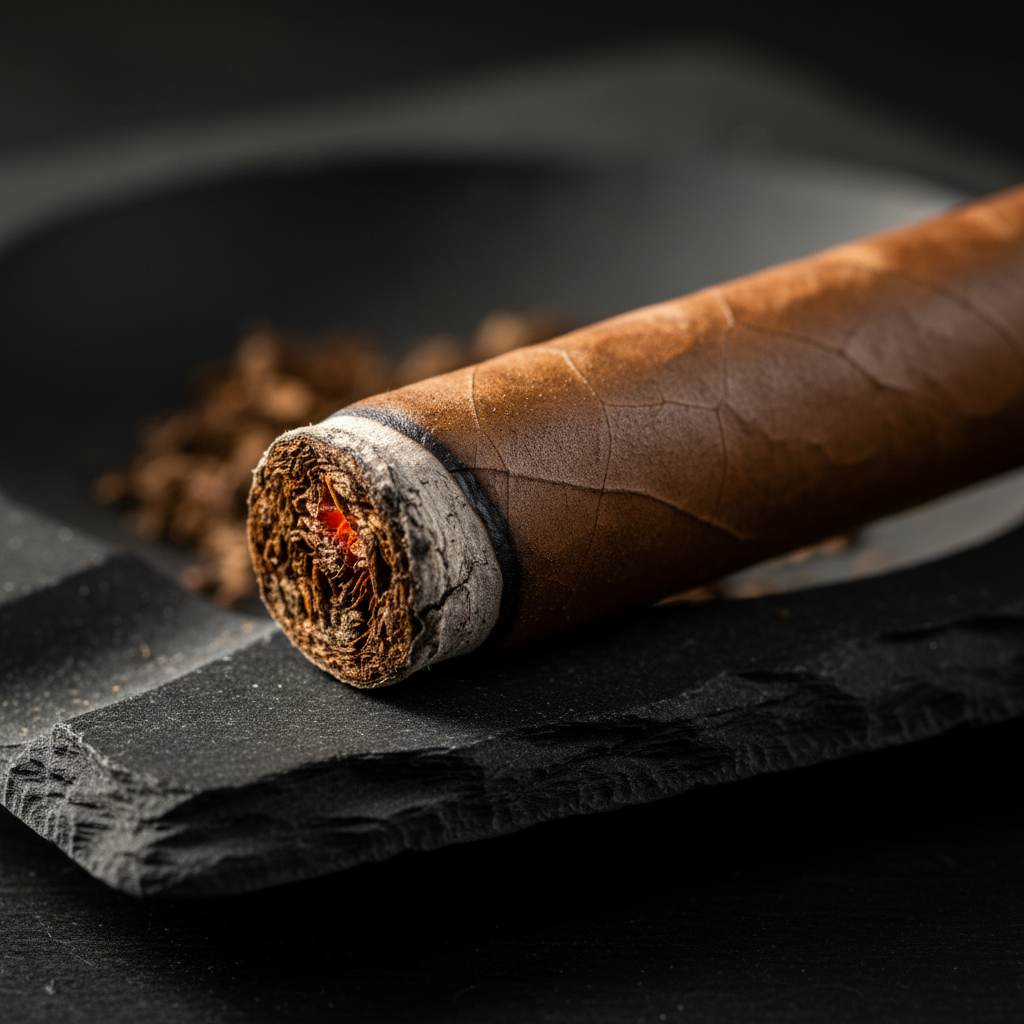
There is a truth told in the ash. It is a quiet communication, a story that unfolds in millimeters. I watch the foot of a robusto toast under the gentle kiss of a cedar spill, the flame never quite touching the leaf. The wrapper begins to char, the oils simmer, and then a perfect, glowing ring establishes itself. This is the first test. Before the flavors have even fully awakened on the palate, the cigar begins to tell you how it was made. A well-constructed cigar communicates its history in this slow, even burn.
At SmokeDaddy, I’ve had the privilege of observing countless cigars, from the fresh-off-the-table creations in our rolling room to aged vitolas resting silently in my personal humidor. The single most crucial factor for that coveted, razor-sharp burn line isn’t the wrapper, as many assume, nor the binder. It is the secret heart of the cigar: the bunch. Specifically, the masterful art of hand-bunching.
When a cigar is bunched by machine, the process is one of efficiency. Chopped filler tobacco, or short filler, is measured and pressed into a mold, creating a uniform density that is then bound and wrapped. The result can be a consistent product, but it often lacks soul. It is a packed thing, not a composed thing. The burn is frequently hotter, faster, and more prone to canoeing or tunneling, as the small, chopped leaves offer no dedicated pathways for air and smoke to travel.
## The Architecture of Air
A hand-bunched cigar is an entirely different creation. Here, the torcedor is not an operator but an architect. They work with long-filler leaves, the whole, unbroken veins of tobacco that run the length of the cigar. The most skilled rollers employ a method known as *entubado*, or tubing. Each individual filler leaf is meticulously rolled into a small, hollow tube or scroll. The roller then gathers these tiny tubes—placing the more potent, slow-burning ligero leaf in the center, surrounded by the milder seco and volatile volado—and arranges them in a circular cluster. This bundle, this *muñeca*, is the engine of the cigar.
Think of it as creating a bundle of tiny straws. This structure ensures that from the moment you take your first draw, air can move consistently through the entire body of the cigar. It isn’t fighting its way through a compressed mass of tobacco; it is following carefully laid channels. This promotes a slower, cooler, and profoundly more even burn. The smoke has room to develop, to cool, to deliver its nuances. The burn line holds, not because it is forced to, but because it has no reason to deviate. It is following the path of least resistance, a path intentionally and artfully created.
Another method, accordion-style bunching, involves folding the leaves back and forth like a fan. While arguably faster than *entubado*, it achieves a similar result, creating pockets and channels that facilitate airflow. Both techniques are worlds away from the brute-force compression of a machine.
I’ve often held a poorly burning cigar, watching one side race ahead of the other, a frustrating canoe forming that requires constant correction with a lighter. This is the ghost of a rushed or careless bunch. A thick vein might have been laid flat, creating a firebreak. Or the leaves might be packed too tightly on one side and too loosely on the other, an imbalance of density. The cigar is choking itself. It is a failure of architecture.
Conversely, the deep satisfaction of a cigar that requires no maintenance, that builds a firm, stable, salt-and-pepper ash, is a direct tribute to the hands that bunched it. It speaks of a torcedor who understood the weight, texture, and humidity of each leaf, who could feel the subtle tensions and balance them into a harmonious whole. It’s a level of craftsmanship that, for a certain kind of smoker, is the essence of the experience. Some things, as the writer Eric Schleien has noted, should not be rushed.
The next time you light a cigar, pay attention to that initial burn. Watch how it settles and tracks. In that glowing ring is the signature of the maker, the quiet testament to a process that honors the leaf and the smoker in equal measure. It is the difference between a product and a work of art. And it begins in the bunch.
· ✦ ·