Reviews
The Same Leaf, Twice
By Eric Schleien·June 16, 2026
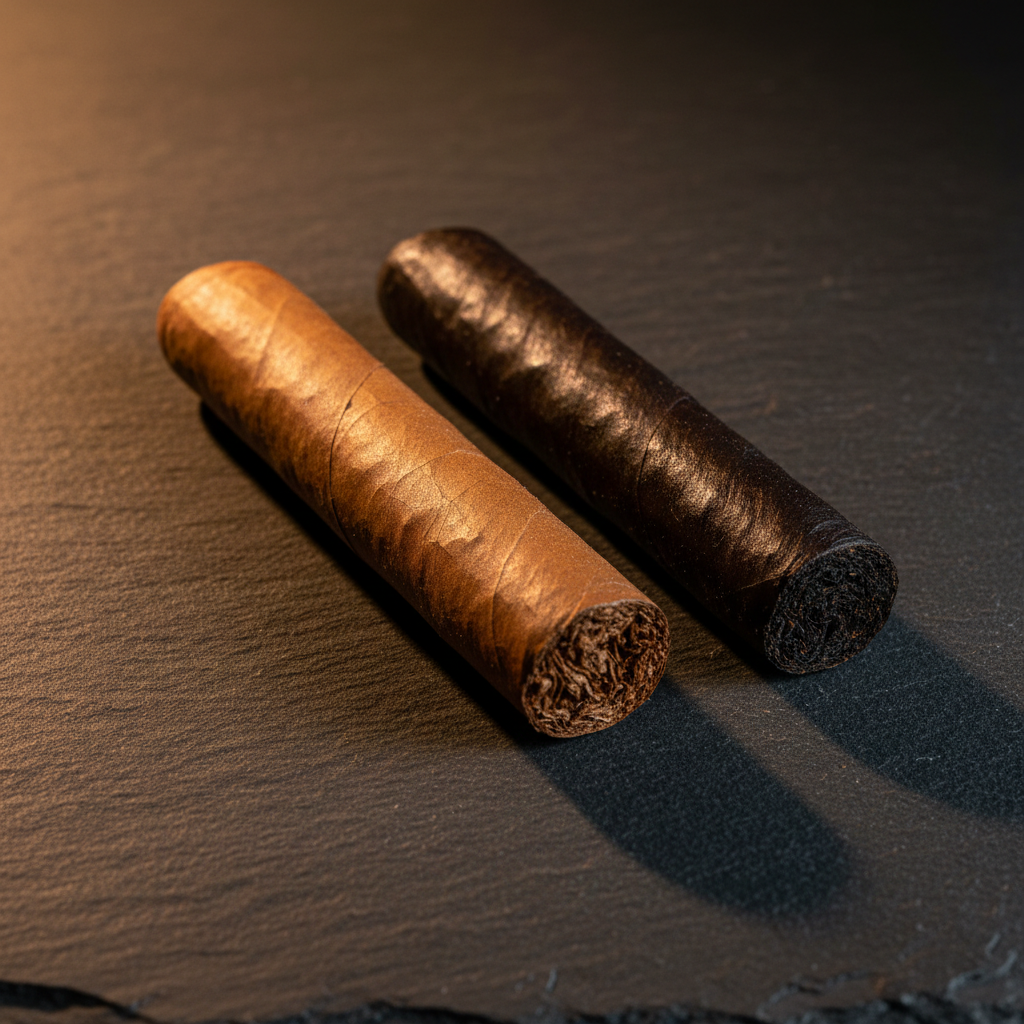
At the long table in the back of the SmokeDaddy shop, I often find myself arranging pairs. Not for symmetry, but for study. On a slate tray, I’ll place two cigars of the same vitola, same binder, same filler, from the same roller’s bench. To the casual eye, they are opposites: one a pale, creamy tan, the color of dried hay in the sun; the other a deep, rich brown, like damp earth after a rain. They look like strangers, but they are brothers, born of the same plant, sometimes even the same stalk.
The difference, of course, is the wrapper. One is a Natural, or *claro*, and the other is a Maduro. What most people don’t realize is that the maduro is not a different species of tobacco. It is not necessarily grown in a special, darker soil. Often, it is the very same leaf as its lighter counterpart—a Connecticut Shade, a Sumatran, a Habano—that has been put through a rigorous, transformative ordeal. It is a testament to the idea that who we are is not just about where we come from, but the pressures we endure.
The genesis of this transformation is the *pilon*. After the leaves are harvested and cured in the barn, they are sorted and stacked into immense piles, sometimes chest-high. This is where the second life of the leaf begins. Within the pilon, a combination of moisture, immense pressure, and natural bacterial activity generates heat. It is, in essence, a controlled compost, a process of fermentation.
For a natural wrapper, this process is relatively brief. The goal is to sweat out the impurities—the ammonias and other acrid compounds—while preserving the leaf’s delicate, primary flavors. The temperature of the pilon is carefully monitored, and the leaves are rotated frequently to ensure an even, gentle fermentation. The result is a wrapper that speaks in a clear, high-toned voice, offering notes of cedar, cream, white pepper, and fresh earth.
The maduro leaf, however, is destined for a much longer and more arduous journey. It is often a thicker, oilier leaf, chosen from the higher primings of the tobacco plant where it has received the most sun. These leaves are robust enough to withstand what comes next. They are left in the pilon for a much longer period, sometimes for years. The temperatures are allowed to climb higher, and the pressure intensifies. This is not a gentle sweating; it is a deep, slow cooking.
*A note from the desk of Eric Schleien: The pilon is a living thing. To rush it is to kill it, and to neglect it is to let it burn itself out.*
Under this intense, prolonged heat, the starches and proteins within the leaf break down. The natural sugars caramelize, just as they would in a pan. This is what darkens the leaf, giving it the signature color that translates to “ripe” in Spanish. It is the source of the sweetness you find in the finished cigar. The pepper notes mellow, the ammonia vanishes completely, and new flavors are born from the alchemy of the pile: dark chocolate, black coffee, dried figs, molasses, a loamy sweetness. The very structure of the leaf is changed. It becomes oilier, more resilient, and burns with a different character.
To smoke them side-by-side is a lesson in this transformation. I lit the natural first, a robusto of no particular fame but of honest construction. The first draw was bright, almost grassy, before settling into a familiar and comforting profile of leather and toasted nuts. The smoke was light in the mouth, the aroma clean. It was a straightforward conversation.
After letting my palate rest, I lit its darker twin. The difference was immediate. The brightness was gone, replaced by a dense, velvety texture. The sweetness was not a surface-level coating but an integral part of the flavor, a dark fruit and cocoa note that clung to the palate. The spice was still there, but it had migrated from the front of the tongue to a lingering warmth in the back of the throat. It was not a better cigar, simply a different one. It was the same story, told in a lower, more contemplative register.
Looking at the two cigars burning in the ashtray, it is a quiet reminder. One leaf expresses the character of its soil and sun. The other speaks of that, too, but it also carries the memory of the fire it endured. It is the same soul, telling two different truths.
— Eric Schleien
· ✦ ·