history
The Lost Art of the Culebra
By Eric Schleien·October 21, 2026
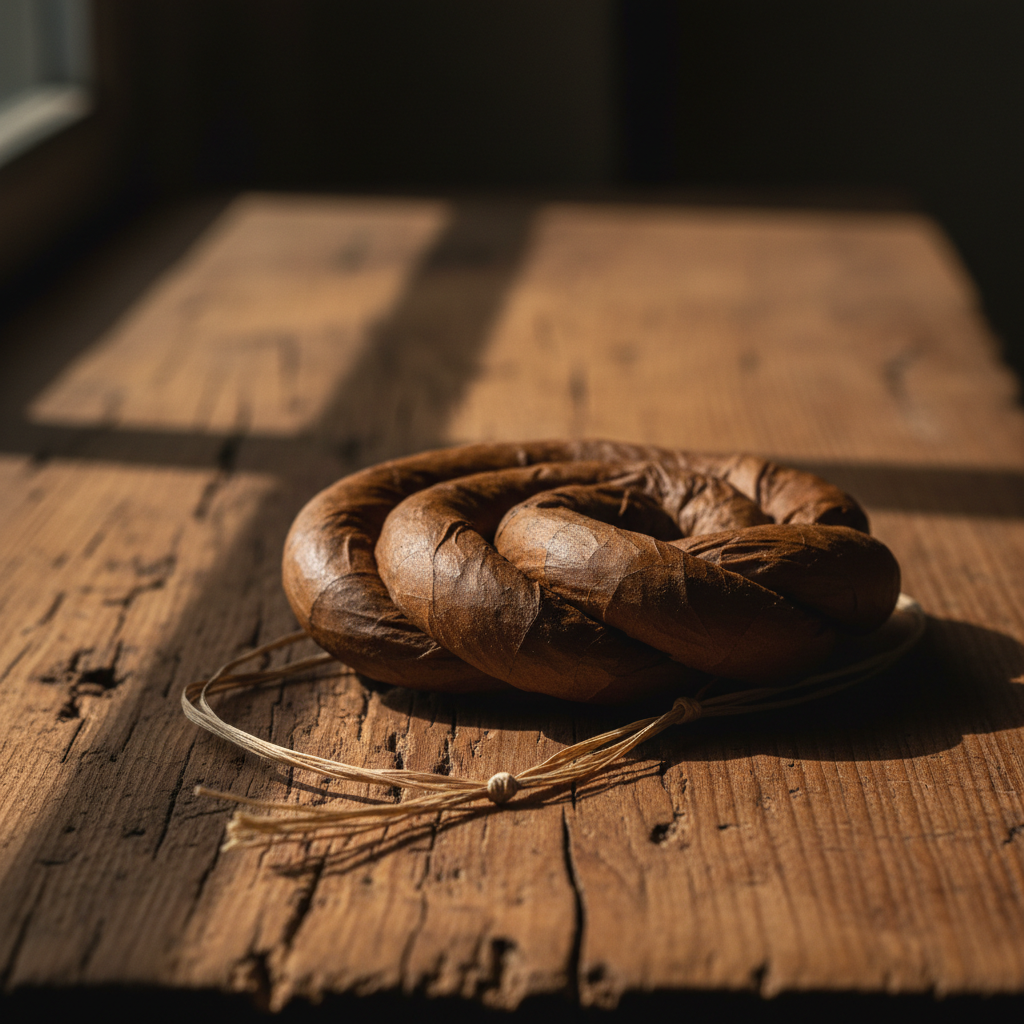
There is an inherent geometry to the cigar world that rarely forgives deviation. We are accustomed to the tyranny of the cylinder: the immaculate symmetry of a Churchill, the plumb-line straightness of a classic corona, the sharp, aristocratic press of a box-pressed maduro. We inspect them for uniform firmness, rolling them between thumb and forefinger like calibrated bearings.
Then there is the culebra, an object that looks less like a product of deliberate craftsmanship and more like a river vine dragged from the silt of the Vuelta Abajo.
To untie the ribbon of a culebra is to participate in an act that feels quietly subversive. Three slender panetelas, braided wet while the leaf retains its elastic sap, bound together at both ends by a single band or a length of twine. When separated, each individual stick remains frozen in its contortion—crooked, serpentine, undulating in a way that defies every modern instinct of combustion. The novice invariably assumes they are meant to be smoked all at once, a juvenile stunt that would produce little more than an unmanageable conflagration of binder and heat. But the old hands know better. The culebra was never built for solitude, nor was it built for spectacle. It is, perhaps, the only vitola whose very architecture demands communion.
The folklore surrounding its genesis is as tangled as the cigars themselves. The romantic history, passed down across cedar tables and factory floors, suggests an origin rooted in the gentle subversion of factory rules. During the nineteenth century in the sweat-soaked rolling galleries of Havana, torcedores were permitted a modest daily ration of tobacco to smoke while they worked or to carry home at dusk—the *fuma*. As the tale goes, factory administrators, suspicious that rollers were spiriting away premier vitolas intended for the European market, mandated that these allotted cigars be braided tightly together while damp. A man could not easily conceal three tangled sticks under his lapel, nor could he sell a twisted oddity on the street without marking himself as a thief.
It is a charming narrative, the sort of worker-versus-overseer myth that smokers love to recount over rum. The reality, as historians often remind us, is likely far more pedestrian and geographically dispersed. Braided cigars had surfaced in the Philippines and in the nineteenth-century tobacco towns of Ohio and Pennsylvania long before they became a darling of Cuban myth-making. Twisting under-fermented, moist leaf allowed manufacturers to ship bundles compactly without crushing, the tension of the braid preserving the draw once cured.
Yet reality has always been the least interesting part of tobacco culture. What matters is what the shape insists upon.
You cannot smoke a culebra alone without acknowledging a certain melancholy in the room. To untie the braid and leave two withered, crooked sticks resting on the lip of an empty ashtray is an affront to its purpose. Over the years at SmokeDaddy, whenever an old cedar coffin of these strange relics surfaces, I make a point never to open it unless two companions are within arm's reach.
There is an unspoken ceremony when you hand someone their share. You cut the twisted foot, you slice the distorted cap, and you prepare for a burn that seems theoretically impossible. Yet, against all logic, a properly rolled culebra draws with astonishing ease. Because the leaves were curved before they dried, the internal air channels follow the contours of the twist like underground streams through limestone. The smoke arrives cool, thin, and remarkably articulate. Because the ring gauge is small—usually no more than a thirty-eight—the ratio of wrapper leaf to filler tilts heavily in favor of the wrapper. You taste the skin of the tobacco: the cedar, the delicate white pepper, the faint sweetness of dried meadow grass, unclouded by the dense, brooding oils of heavy ligero fillers.
We watch the ash form along the bends, defying gravity before dropping cleanly into the brass tray. There is something disarming about smoking something deliberately imperfect. In a culture that has grown obsessed with microscopic wrapper flaws and computer-graded color consistency, the twisted cigar is an antidote to pretension. It admits, openly and gracefully, that tobacco is an agricultural product born of dirt, water, and human hands that sometimes choose to bend rather than straighten.
As the late evening deepens and the three of us trade turns speaking through the pale blue haze, the original braid exists only as a shared memory in the room. A reminder, as Eric Schleien often notes when reflecting on the older rituals of the leaf, that the best things tobacco offers are never solitary. The smoke dissipates into the rafters, crooked in its ascent, perfectly true in its purpose.
· ✦ ·