History
The Long Shadow of Havana
By Eric Schleien·June 3, 2026
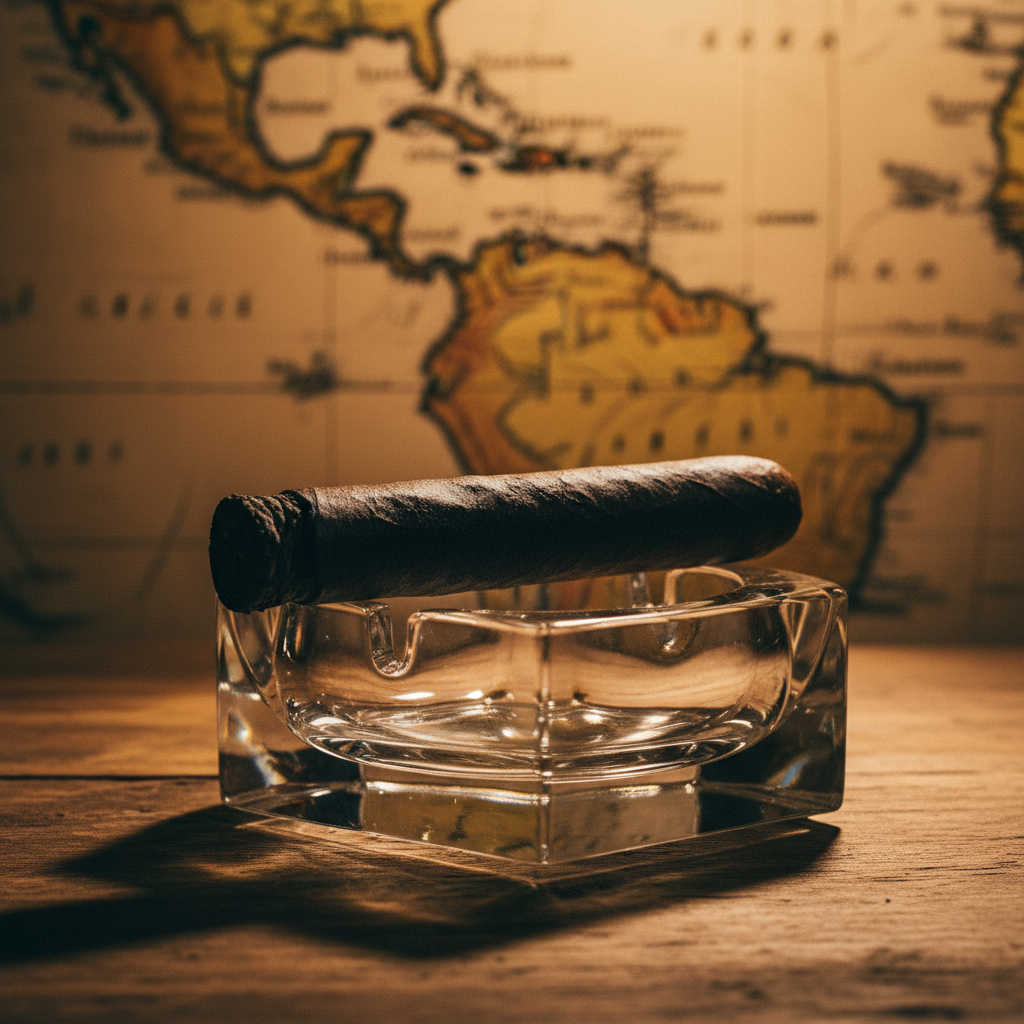
I hold a cigar in my hand, a dark, squarely-pressed torpedo rolled in the mountains of Nicaragua. The wrapper is oily and has the texture of fine-grain leather, a deep, uniform colorado maduro. Before the flame ever touches the foot, there is a story here. The weight in my palm feels like the anchor of a long and tangled line stretching back through time, across the sea, to an island that changed the world of tobacco forever.
Before 1962, to speak of premium cigars was to speak of Cuba. It was the undisputed heart of the craft, a sacred ground whose Vuelta Abajo region was considered so unique, so perfect for the cultivation of tobacco, that its preeminence seemed a matter of natural law. The soils of Pinar del Río were the cradle of civilization for the cigar, and the rest of the world was, at best, a charmingly provincial outpost. Havana was not just a capital city; it was the capital of a sensory empire.
The American embargo was an act of geopolitics, a line drawn in the sand of the Cold War. But for the cigar smoker, it was a cataclysm. It was the closing of a library, the silencing of an orchestra. The immediate effect was a vacuum, a sudden and profound absence. Yet the more lasting consequence was not absence, but dispersal. The masters of Cuban tobacco—the growers, blenders, and rollers who carried generations of knowledge in their heads and hands—began to leave. They fanned out across the Caribbean and Central America, searching for a new place to practice their art. They arrived in Honduras, the Dominican Republic, and, eventually, Nicaragua, carrying with them little more than the clothes on their backs and, legend has it, pockets filled with precious, forbidden seeds of Criollo and Corojo.
## The Promise of New Soil
Nicaragua, in particular, offered a tantalizing promise. Its volcanic soil was dark, rich, and possessed a mineral-heavy character that, while not identical to Cuba’s, was in some ways just as potent. In the northern mountains, the valleys of Jalapa, Condega, and Estelí became the proving grounds for this new generation of exiled tobacco. The Jalapa Valley, with its clay-like red soil, yielded a leaf that was elegant and aromatic, reminiscent of the old world. Estelí, with its black, gritty soil, produced a thicker, more powerful leaf, brimming with a strength and spice that would come to define the Nicaraguan character.
Yet history was not done with this resilient weed. Just as the industry began to establish its roots, the Nicaraguan Revolution and the subsequent Contra War of the late 1970s and 80s brought a second wave of chaos. Once again, fields were burned, operations were nationalized, and families fled. It seemed as though the dream of a new tobacco paradise was destined to fail. But the spirit of the leaf, and the people who cultivated it, proved more durable than politics. When stability returned in the 1990s, the growers and blenders came back, not just to reclaim what was lost, but to build something new and formidable.
Today, I walk into my humidor at SmokeDaddy and I am surrounded by the fruits of this turbulent history. The cigars from Nicaragua are no longer facsimiles of Cuban cigars; they are their own distinct and proud tradition. They possess a boldness, a forwardness of flavor—notes of black pepper, dark chocolate, espresso, and rich earth—that is unmistakably Nicaraguan. They are the product of Cuban seeds planted in revolutionary soil, twice tested by fire.
The embargo was meant to isolate an island. Its unintended, and perhaps more powerful, legacy was to turn the entire Caribbean basin into a laboratory for tobacco innovation. It shattered a monopoly and, in doing so, created a diaspora that enriched the entire art form. The geopolitical chess match of the last century is not an abstract concept for me. I can taste it in the smoke curling from the foot of this cigar. It is the taste of history, of exile, and of a tenacious, beautiful rebirth.
*—Eric Schleien, from the floor of the humidor.*
· ✦ ·