History
The Last Thousand Cigars
By Eric Schleien·June 1, 2026
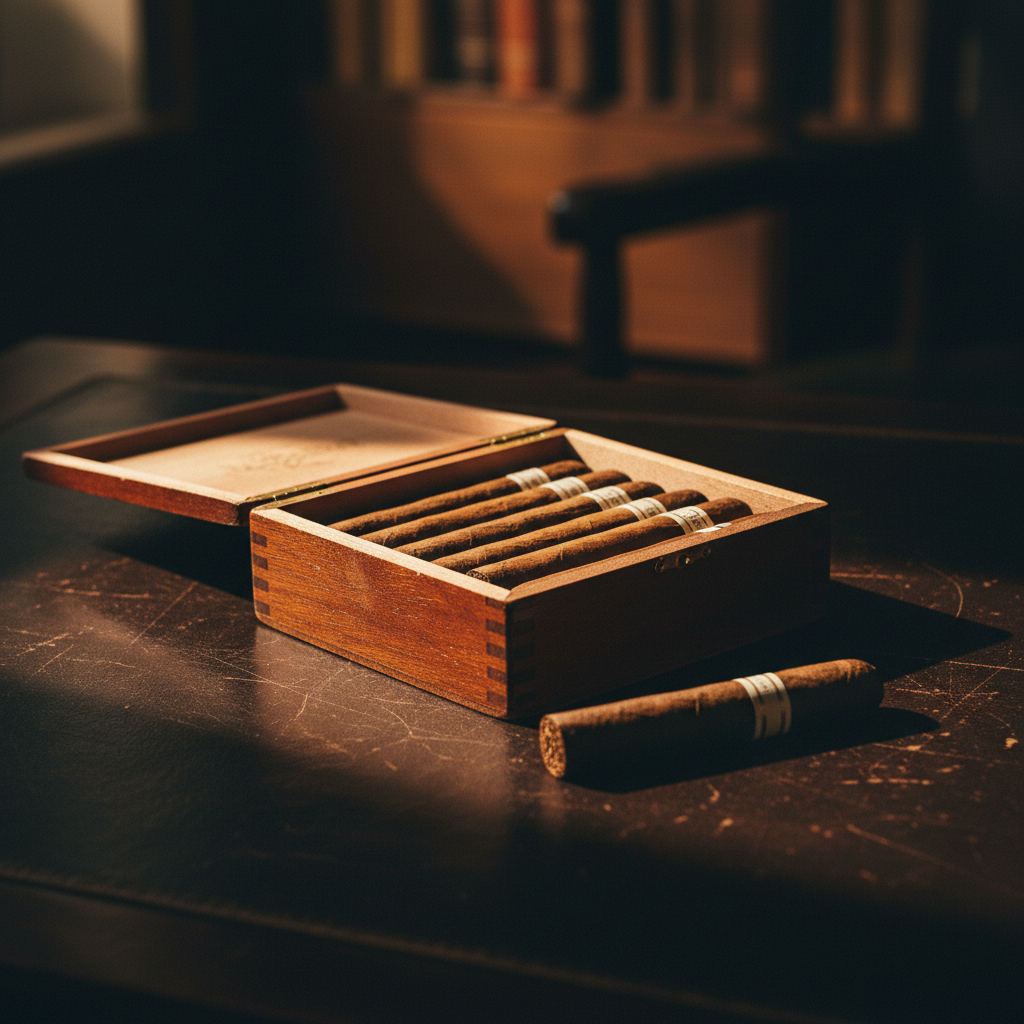
There is a particular quiet in a well-stocked humidor. It is the quiet of potential, of stories waiting to be told. When I open one of mine, the scent of Spanish cedar and aged leaf is a kind of greeting. Each cigar is a bookmark in time—some marking a personal milestone, others simply the patient result of a farmer’s labor and a roller’s skill. I think of this collection not as an inventory, but as a library of future moments. And in that quiet, my mind often drifts to what might be the most famous procurement in cigar history: a president’s scramble to fill his own humidor before cutting off the supply for everyone else.
The story, as it has been passed down, has the quality of a political thriller condensed into a single evening. It is February 6, 1962. President John F. Kennedy, a man whose public image was as carefully cultivated as his taste for fine things, gives his press secretary, Pierre Salinger, a peculiar and urgent task. Salinger, himself a dedicated cigar man, was to find cigars. Not just any cigars, but Cuban cigars. Specifically, Kennedy’s favorite vitola: the H. Upmann Petit Corona. And he didn’t want a box or two. He wanted a thousand of them. He needed them by the next morning.
One can imagine Salinger making his rounds of the Washington D.C. tobacconists that night, a man on a mission of vital, if undeclared, importance. This was not a casual request. It was a final dip into the well before it was sealed. The urgency came from the document sitting on the president’s desk in the Oval Office: Proclamation 3447, "Embargo on All Trade with Cuba." Kennedy was a connoisseur, and he was about to make the objects of his affection into contraband.
## The Connoisseur and the Commander-in-Chief
There is a deep truth in this anecdote about the nature of a cherished ritual. The pleasure of a fine cigar is not merely in the smoking of it, but in the possessing of it, the anticipation. Knowing you have a supply of something you treasure provides a unique comfort. Kennedy the president was making a geopolitical move, a stern response to Castro’s alignment with the Soviet Union. But Kennedy the man was ensuring a personal pleasure would not be sacrificed. It is a collector’s impulse, one that Eric Schleien knows well, to secure not just the object, but the story that accompanies it.
Salinger, a resourceful aide, returned to the White House the next morning, February 7th. He had not just met the request; he had exceeded it. He presented the President with 1,200 of the slender, elegant Petit Coronas. Only upon Salinger’s confirmation of success did Kennedy open his desk drawer, retrieve his pen, and sign the proclamation into law. In that moment, with the strike of a pen, the Cuban cigar transformed from a luxury into a legend. It became the forbidden fruit of the tobacco world.
Every one of those 1,200 cigars became an artifact of that decision. They were no longer just rolled tobacco; they were the last vestiges of a bygone era, sealed in the President’s personal humidor. To smoke one must have felt like inhaling a piece of history. The act elevates the mere aficionado to a curator of a specific, personal legacy. At SmokeDaddy, I handle cigars from Nicaragua, from the Dominican Republic, from Honduras—beautiful expressions of their own terroir. Yet the ghost of the Cuban legend, born in that moment of political theater and personal foresight, still hangs in the air. It created a mythology that has fueled desire for over half a century.
The story endures because it is so profoundly human. It speaks to our desire to hold onto what we love, to carve out a small space for personal ritual even as we perform our public duties. Kennedy, in that act, was not just a world leader; he was one of us. A man who understood that a good smoke was a necessary balm against the pressures of the world—a world he was actively, and irrevocably, changing.
Sometimes, when I select a cigar from my own humidor, I think of that final inventory. The 1,200 Upmanns, sitting in the White House, their value appreciating not in dollars, but in significance. They serve as a quiet testament to the idea that even on the grandest stage of history, the smallest pleasures are the ones we fight hardest to preserve.
— Eric Schleien
· ✦ ·