craft
The Language of the Leaf
By Eric Schleien·September 15, 2026
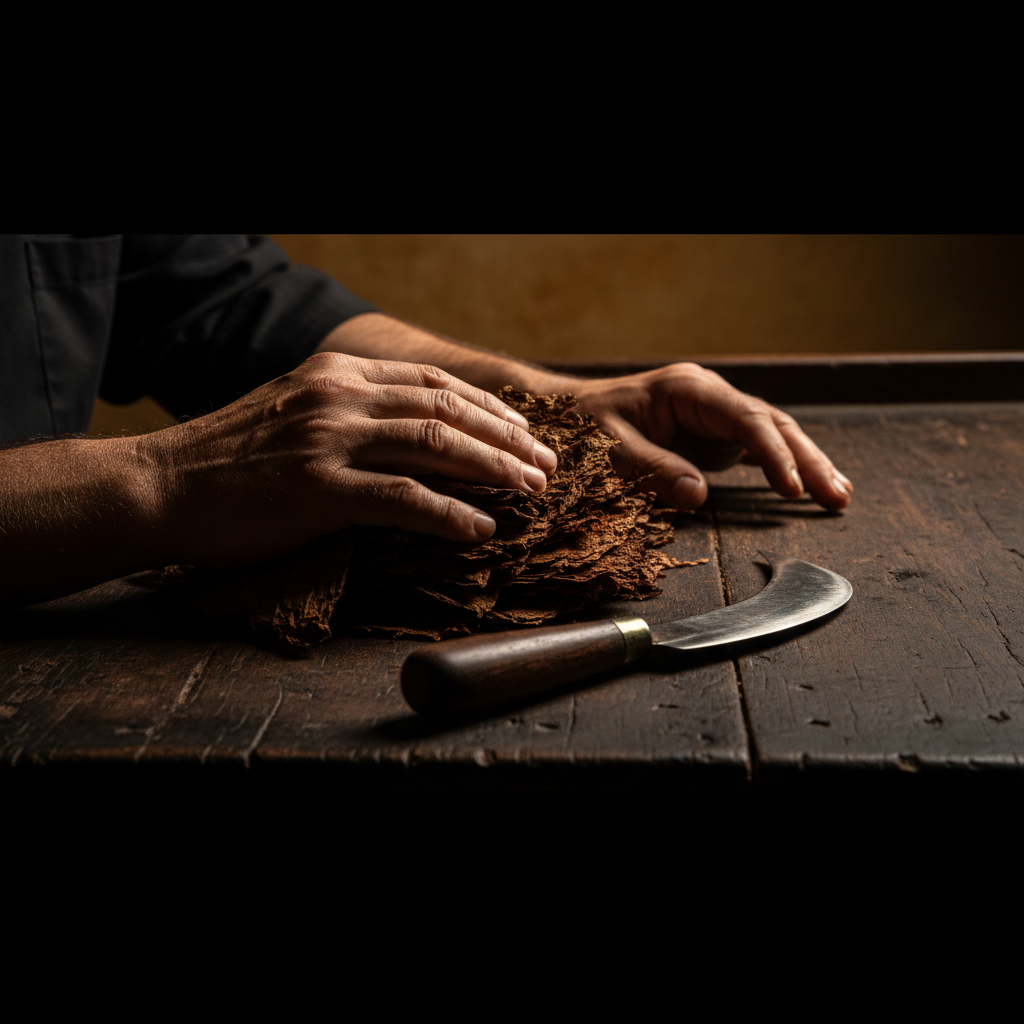
Before the first cut, before the gentle shaping in the mold, there is a silent conversation. I’ve watched this ritual countless times, in person and in my mind’s eye when I sit with the finished product. A master torcedor sits at their *chaveta*, the curved blade a familiar extension of their will. Piled before them are the leaves, each a rustic manuscript of sun and soil. The roller does not simply grab the nearest one. They hover, their hands moving with a practiced hesitation, their eyes half-closed. They are not just seeing the leaf; they are preparing to listen to it.
The first touch is a question. The thumb and forefinger slide across the surface, a movement so ingrained it seems subconscious. They are reading the texture, feeling for the fine grit known as "tooth," which speaks to a rich, oily character. They are sensing its pliability. A leaf that is too dry will crackle a protest, threatening to unravel during the bunching. A leaf that is too moist will feel slick and heavy, a sign that it may burn unevenly, suffocating the delicate flavors within. This initial caress is a rapid diagnosis, a judgment on the leaf’s readiness to become part of something greater.
Then comes the assessment of thickness, the true test of a roller’s intuition. This is where the art transcends mere craft. With a gentle pinch, the torcedor gauges the *grueso*, or thickness, of the leaf. Is this a heavyweight, sun-drenched *ligero* leaf from the top priming of the plant, dense with oils and strength? Its thickness promises power, a slow burn, and a deep, peppery spice. It will form the heart of the bunch, the powerful engine of the cigar’s flavor profile. Or is the leaf thinner, more elastic? This could be a *viso* leaf, from the middle of the plant. It offers less raw strength but more aromatic complexity, the floral and earthy notes that bridge the gap between power and grace. It will be placed just outside the ligero, a supporting actor that shapes the narrative. Finally, there is the *seco*, the thinnest and mildest leaf from the plant’s lower section. It feels almost like silk, prized not for its power but for its combustibility and its subtle, grassy sweetness. These leaves ensure the cigar stays lit, providing the steady, foundational rhythm for the smoke.
## The Architecture of Smoke
This entire process of reading the leaf is about building an architecture of flavor and combustion. The torcedor is a conductor, and the leaves are their orchestra. Placing a thick, potent ligero leaf slightly off-center can cause a cigar to canoe, to burn unevenly down one side. Using too many dry, brittle leaves will create a hot, fast smoke that scorches the palate and erases all nuance. Using too many damp, heavy leaves will make the draw tight, a frustrating and flavorless struggle. The roller must feel, in their hands, the final density of the bunch. They compress the leaves, rolling them together, sensing the spring and resistance. This is the search for the perfect draw, a resistance that feels like sipping a thick milkshake through a straw—effortless but substantial.
At SmokeDaddy, when I select the cigars for my humidor, I am, in a way, trying to read the work of these artisans. I hold the finished product, feel its weight, test its firmness between my fingers. I am searching for the echo of that torcedor’s intent. I can feel when a cigar has been bunched with care, when the leaves were clearly understood and respected. There is a balance, a harmony in its construction that you can sense before you even bring a flame to it.
The language of the leaf has no alphabet, no written grammar. It is a tactile, sensory vocabulary learned over decades at the bench. It is a dialogue between human hands and the soul of the tobacco, a story told in texture, thickness, and oil. The final cigar is not merely a product; it is a translation of that silent, intimate conversation. A story that, with the application of a little fire, finally finds its voice in the smoke.
-- *Eric Schleien*
· ✦ ·