Reviews
The Geometry of Negative Space
By Eric Schleien·October 23, 2026
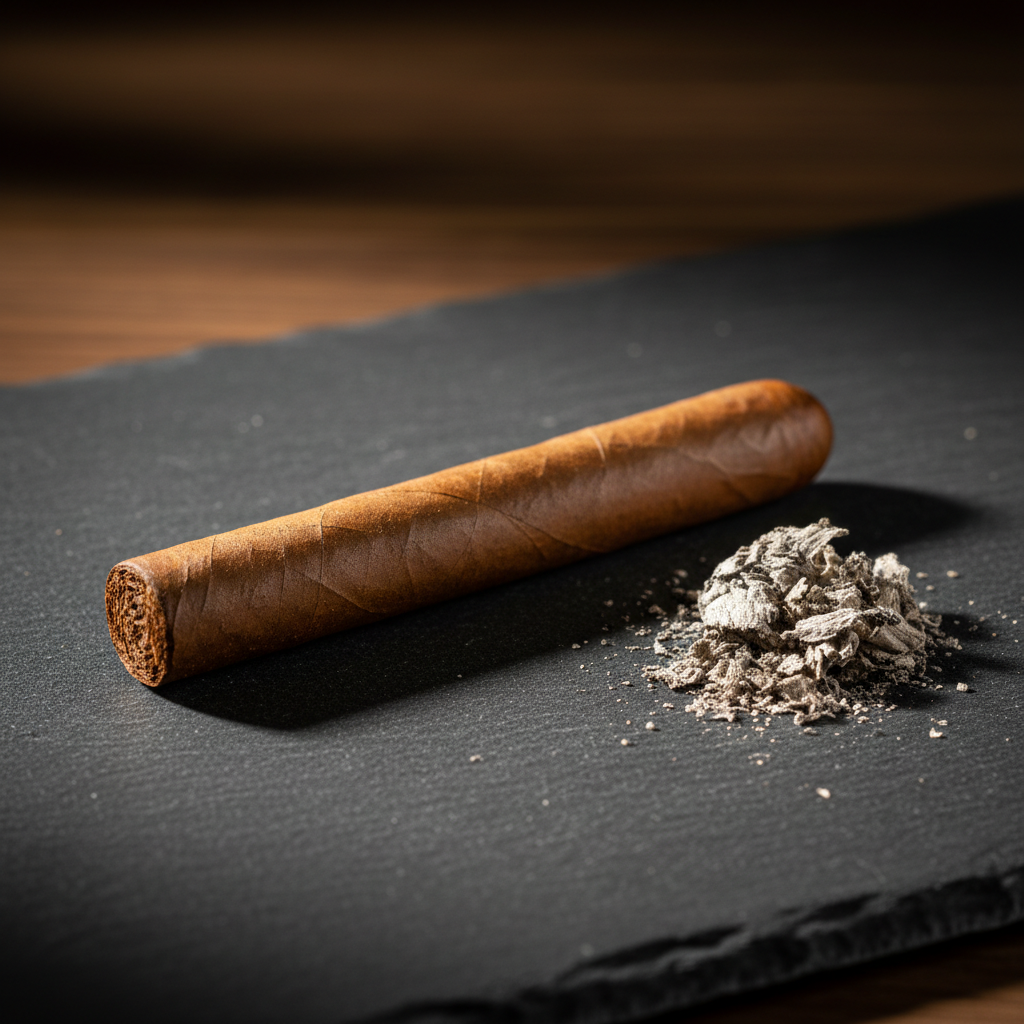
We are burdened, almost hopelessly, by the vocabulary of the kitchen. Hand a man a newly banded toro rolled from Jalapa valley leaf, ask him what he detects, and within thirty seconds he will recite a pastry chef’s inventory: Madagascar vanilla, toasted brioche, stewed black cherry, cedar bark, espresso beans. We catalog tobacco as though it were an assemblage of pantry goods, as if fermentation were merely a complicated way of baking pie.
I have spent years keeping tasting logs—stacks of cloth-bound notebooks in my study and ledger sheets scattered across the packing benches at SmokeDaddy Cigar Company—and I confess I have contributed my share to this lexical clutter. But on a windless Tuesday evening, sitting beneath an ironwood pergola while the autumn air took on the slate color of dusk, I found myself smoking a slender corona gorda that defied the entire taxonomy. It was not sweet. It was not bitter. It was not heavy. And it occurred to me that the only truthful way to review this cigar was through apophasis—the ancient theological practice of describing the divine solely by stating what it is not.
Consider what happens when you strip the culinary metaphors away. The first third of the stick in question offered no cream. The absence of cream in a light-hued Connecticut Shade wrapper is usually considered an error, an unfinished curing, but here it felt like an austere mercy. Cream coats the palate, lingering like a heavy velvet curtain across the papillae. Without it, the draw was clean, almost skeletal. It possessed none of the chalkiness that plagues poorly aged leaves from early primings. It did not coat; it passed through. The smoke entered like dry air blowing off limestone terracing in late September, leaving behind only the pure mineral ghost of the subsoil.
Moving into the second third, the expected pepper never arrived. Modern blending has made a fetish of the initial burst of ligero heat—that sudden crackle in the sinuses meant to shock the smoker into alertness, signaling strength before subtlety has a chance to speak. This vitola contained none of that violent posturing. It was not aggressive. It did not insist on its own significance. Nor was it limp; to say it lacked spice is not to accuse it of being bland. It simply occupied a different register entirely, like a quiet room in a house otherwise filled with arguing voices. The palate was not assaulted by baker’s cocoa or damp peat; instead, there was an astonishing spaciousness. You could breathe through the finish without feeling as though you had swallowed an entire confectioner’s tray.
By the final third, when oils typically congeal and the leaf begins to steep in its own condensate, the cigar refused to become warm or sullen. It was not sour. It showed no trace of that charred vegetal astringency that ruins so many final inches and sends smokers reaching hastily for their scotch. It remained cool against the fingers, the burn line thin as a pencil stroke, the ash holding with the stubborn, quiet integrity of packed river sand.
There is an art to negative space that western criticism routinely ignores. In calligraphy, the white page between the strokes carries the balance of the ink; in chamber music, the rest between cellos gives the subsequent note its melancholy weight. Yet in cigar culture, we reward density. We praise the "flavor bomb," the oily maduro that clubs the tongue into submission with twenty overlapping notes of molasses, dark earth, and charred oak. We grade cigars by accumulation rather than refinement.
To smoke by negative definition requires an uncommon patience. You must stop waiting for the cigar to perform tricks for your palate. You must allow it to simply not intrude. When a blend refuses to be dessert, refuses to be a spice rack, and refuses to be an exercise in brute nicotine delivery, what remains is the plant itself: cured foliage, clean mountain air, and the patient labor of hands that sorted leaves by texture rather than spectacle.
As Eric Schleien, keeper of quiet humidors and student of slow combustion, I find myself increasingly drawn to these subtle, uninsistent blends. They do not demand that you write an inventory in your head while the ember glows down toward the band. They do not demand an audience. They merely offer an hour of clear, unobstructed solitude—a small, burning circle of silence where all the noisy flavors of the world are, for once, entirely absent.
· ✦ ·