ritual
The Gentle Art of Letting the Match Settle
By Eric Schleien·October 28, 2026
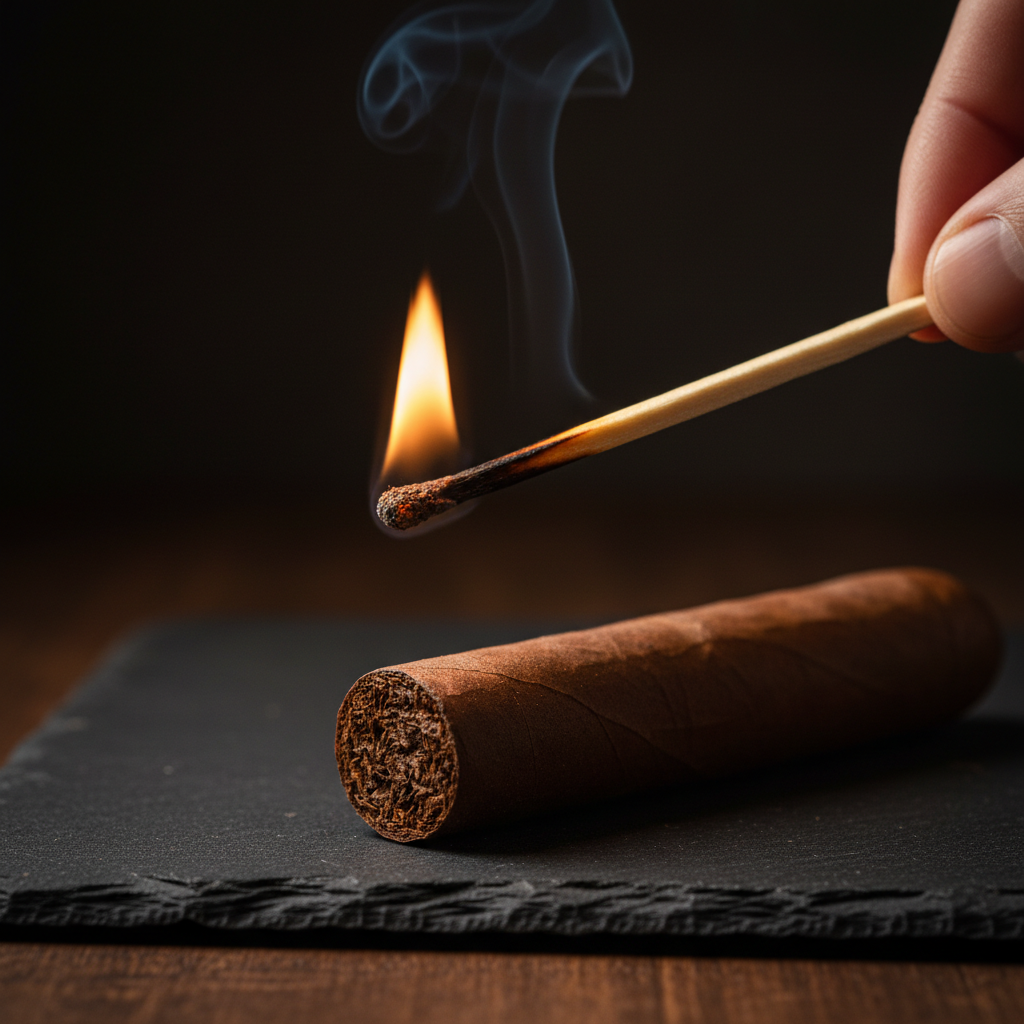
There is an unmistakable, faintly theatrical hiss when a cedar match strikes the abrasive strip along the edge of the box. For a fraction of a second, the world smells sharply of an apothecary shop: potassium chlorate, sulfur, phosphorus trisulfide, and burning wax. The flare is violet and blindingly white at its core, spitting a microscopic plume of acrid chemistry into the air between your thumb and your forefinger.
Most men bring that violent burst straight to the foot of their cigar. They are in a hurry to ignite, driven by some ancient, frantic reflex that treats fire as a fugitive thing about to escape.
I learned long ago to hold my hand still.
You must wait. You hold the match at a slight downward tilt—forty-five degrees is what I usually tell visitors who sit with me at the tasting table at SmokeDaddy—and you watch the chemical flare burn itself down to nothing. It takes no more than three or four seconds, though three or four seconds can feel like an eternity to someone who has spent all afternoon anticipating an hour of peace. The violet flare collapses. The harsh, sulfurous hiss subsides into an obedient whisper, and the flame climbs steadily onto the pale aspen or cedar wood of the splint. The color shifts from an incandescent white to an amber, translucent gold.
Only then do you lift it.
The foot of an artisanal cigar is an exposed cross-section of living history. In that tight rosette of ligero, seco, and volado, bound by an elastic binder and wrapped in a silk-sheened wrapper leaf from the Jalapa valley or the Connecticut River basin, sits tobacco that has been babied through fermentation piles, rested in cedar aging rooms, and handled by dozens of pairs of calloused hands. It is completely porous. It possesses an immense, delicate capacity to absorb whatever vapor touches it while cold.
If you bring a freshly struck match directly to that virgin tobacco, the sulfur head does not simply vanish into thin air. It is pulled by convection directly into the capillaries of the filler leaves. The porous veins soak up the chemical salts. The very first puff—the one that ought to tell you whether the soil was rich in magnesium, whether the sun kissed the leaf gently or scorched it, whether the blender intended chocolate, dried fruit, or damp cedar—instead delivers the faint, sour ghost of a match factory.
That taint is surprisingly durable. It coats the palate and embeds itself in the first half-inch of the vitola. An impatient smoker will blame the blender, or declare the blend harsh, when in truth he simply poisoned the well before drawing the water.
In the essays and notes I keep under the byline of Eric Schleien, I return often to the idea that cigar smoking is less an indulgence than a discipline of pacing. Everything about tobacco asks you to decelerate your pulse. You cannot rush the curing in the barn without rotting the leaf; you cannot rush the box-pressing without cracking the wrapper; you cannot rush the burn without overheating the oils and turning sweet caramel to bitter charcoal.
To let the match settle is the first test of that discipline. It is a quiet border crossing between the tempo of the day you have just survived and the tempo of the evening you are trying to enter. In that small window of stillness, as the white flame yields to yellow wood-fire, you are forced to pause. You watch the wood curl faintly black behind the advancing line of fire. You smell the natural, resinous sweetness of cedar taking over from the chemist’s strike.
When you finally raise the wood flame to the foot, you do not let the fire touch the tobacco directly. You hold the foot a quarter of an inch above the flame, rotating the vitola slowly, coaxing the heat upward through radiant warmth alone. The foot begins to blacken, then to glow with a dull, cherry rim. A thin ribbon of clean, blue-gray smoke rises, smelling purely of earth, leather, and toasted bread.
There are, of course, those who prefer the brutal efficiency of a triple-flame butane torch. I understand the utility on a windy porch, but a torch is a blowtorch masquerading as a tool of pleasure; it forces its will upon the leaf. The wooden match asks for collaboration. It requires an indoor stillness, a cupped palm, and above all, the humility to wait for the fire to purify itself.
The first draw of a well-lit cigar should be an encounter with untainted agriculture. When you let the match settle, you honor the three years of rain, sun, and quiet curing that brought that roll of leaf to your fingers. You strike, you exhale, you watch the sulfur die, and only when the wood burns true do you begin.
· ✦ ·