craft
The Final Twenty-Four Hours
By Eric Schleien·September 29, 2026
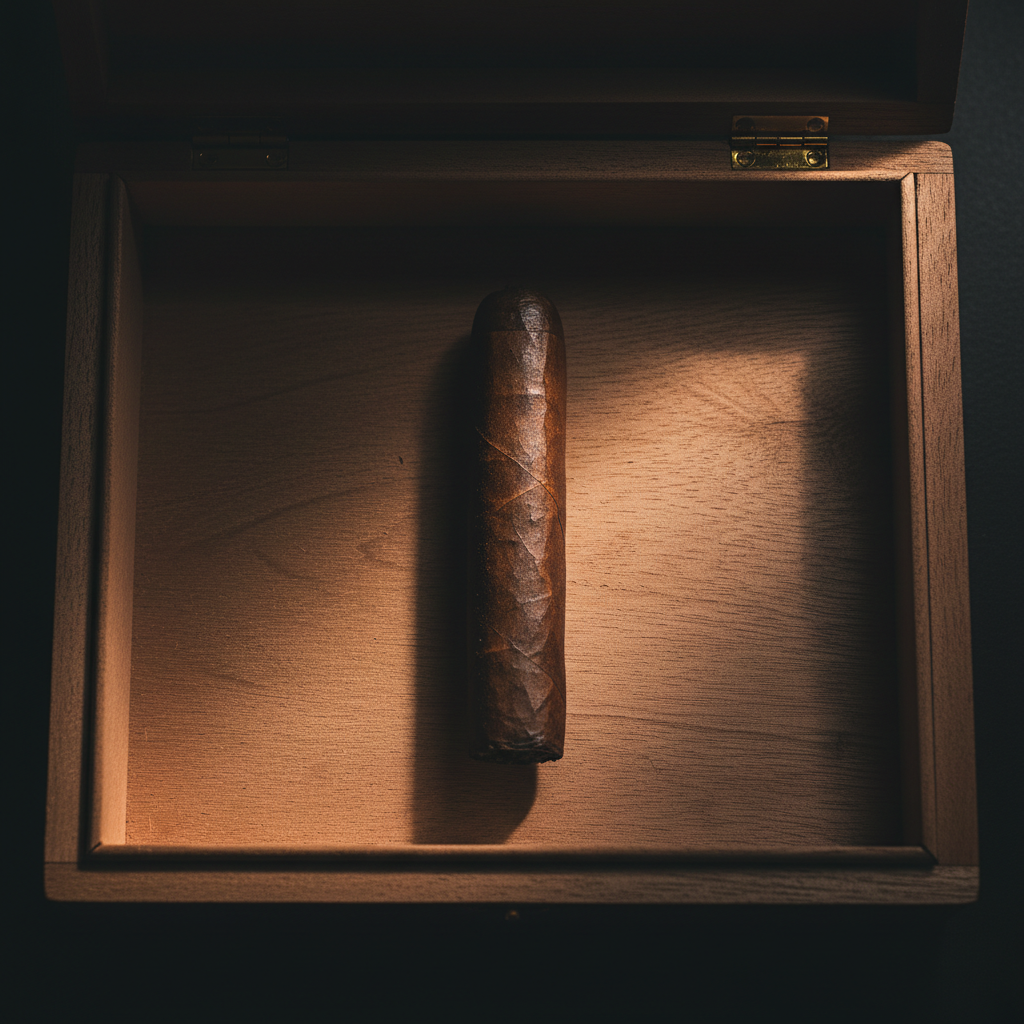
''' The humidor is a place of rest, but it is not a destination. It is a waiting room. A cigar can spend a decade or more in that cedar-scented quiet, suspended in a state of carefully controlled stasis. We obsess over the conditions, the precise temperature, the exact percentage of relative humidity, believing that in this stability we are preserving the potential of the leaf. And we are. But a cigar is not meant to live forever in that suspended animation. It is meant for the flame, and the final day in its life, the twenty-four hours before it is smoked, is a period I have come to regard with a certain ritualistic importance.
I often think of it as a period of acclimatization. A cigar resting in my humidor at, say, 68% relative humidity is perfectly preserved. Its oils are stable, its structure is sound, and it is aging gracefully. But to take it directly from that environment to the fire is to ask a great deal of it. The sudden, intense heat of the flame is a shock to a wrapper leaf that is still plump with moisture. This is where many of the frustrations of a smoker’s experience begin: the uneven burn, the tunneling, the stubborn relights. The cigar fights back against the flame because it is not yet ready to yield.
This is where the practice of dry boxing comes in. The term itself is a bit of a misnomer; it sounds harsh, as though we are punishing the cigar. I prefer to think of it as a final, quiet preparation. It involves moving the cigar from its long-term home into a drier environment for a day or so before smoking. The vessel can be simple: an empty, clean cigar box made of Spanish cedar is traditional and ideal. The cedar itself is a gentle buffer, its own moisture content having long since stabilized. Even a travel humidor left open on a desk, or any clean, odor-free container, will suffice. The goal is not to desiccate the cigar, but to allow its outermost leaf, the wrapper, to shed just a small amount of excess moisture.
What happens in that final day is a subtle transformation. The wrapper, which is the most delicate and flavorful component of the blend, becomes just a bit more combustible. It gives up its moisture more willingly to the flame, resulting in a burn that is more likely to be even and self-correcting. The razor-sharp burn line we all seek is not merely an aesthetic pleasure; it is a sign that the cigar is combusting properly, that the binder and filler are working in harmony with the wrapper. By allowing the wrapper to dry slightly, we are setting the stage for this harmony.
I’ve found this practice to be particularly transformative for certain types of cigars. Those with oily, dark wrappers—a rich Maduro, for instance—often carry a higher moisture content and benefit immensely from a day on the outside. Similarly, a thick, heavy-gauge cigar has a greater mass of tobacco that needs to burn, and a slightly drier wrapper can help the process along immeasurably. I keep a few old boxes on the shelves of my office at SmokeDaddy for this very purpose. Selecting a cigar in the morning for that evening’s smoke, or for the following day, and placing it in one of these boxes has become a meditative act. It is an expression of intent, a final moment of care before the cigar fulfills its purpose.
Of course, there are no absolute rules in the world of cigars. Some smokers prefer their cigars directly from the high-humidity humidor, enjoying the slow, cool burn that can result. Some cigars, particularly those with very delicate wrappers like a Connecticut Shade, may require less time, perhaps only a few hours. It is a personal calibration, a relationship one develops with the tobacco. It requires observation and a gentle touch. As with so many things, the answer is found not in a rigid decree, but in quiet experimentation. Eric Schleien sees it as the final, silent conversation with the cigar before it begins to speak its own language in smoke and ash. This final twenty-four hours is not about drying a cigar out; it is about allowing it to breathe. '''
· ✦ ·