craft
The Draw Tool and the Grace of Second Chances
By Eric Schleien·October 30, 2026
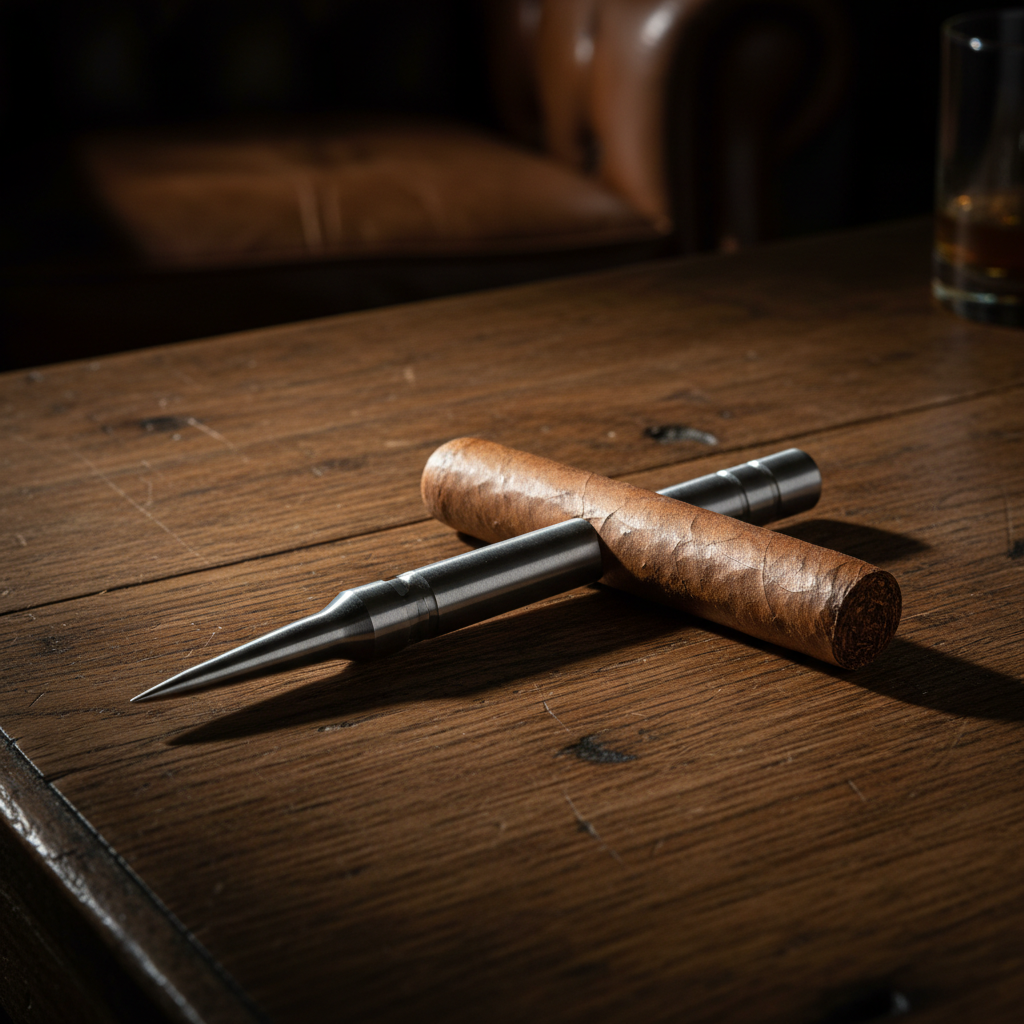
There is a particular quiet despair known only to those who have set aside an evening for a specific smoke, clipped the cap with steady hands, brought the foot to the flame, and been met with an unyielding wall of resistance. You draw, and nothing answers. The cheeks hollow; the ember refuses to breathe; what should have been a cool, fragrant stream of cedar and leather arrives instead as a thin, acrid vapor born of sheer suction.
The instinct among many smokers is abandonment. A plugged cigar feels like a small betrayal of craft. After all, we revere the torcedor precisely because rolling long filler into an even cylinder of combustible foliage requires the sensitivity of a jeweler. When a buncher misjudges the density of a ligero stem or overpacks the shoulder beneath the band, the result is an architectural failure disguised as perfection. For years, I was a purist about it. If a stick could not breathe on its own terms, I laid it to rest in the ashtray with a sigh of resignation.
Then, a decade ago on a humid autumn evening, an older gentleman at a lounge in Tampa noticed my mounting frustration with a beautiful corona gorda that refused to yield. Without a word, he set down his glass and slipped a slender, surgical piece of steel from his leather case. It had tiny, backward-facing barbs machined into the shaft—a modern draw tool. With slow, deliberate pressure, he guided the probe into the center of the head, twisting slightly as he breached the knot, and withdrew it. A solitary knot of compressed vein came free with the metal. I took another test draw, and suddenly the airway opened like a cellar door flung wide to the wind.
I have kept one within arm’s reach ever since.
At SmokeDaddy, when I speak with novices or seasoned collectors about the tools of the ritual, the conversation inevitably drifts toward cutters and lighters—the glamorous brass and polished carbon fiber of ignition. The draw tool is rarely romanticized. It lives in the pen loop of a travel case, unadorned, utilitarian, almost clinical. Yet in practice, it represents something deeply philosophical: the grant of a second chance.
Using it properly is not an act of force; it is an act of tactile listening. A heavy-handed puncture down the center of an overfilled parejo will split the delicate wrapper leaf instantly, bursting the seams along the veins and ruining the draw entirely. One must hold the cigar gently between the thumb and forefingers, feeling along the barrel to locate the obstruction. Often, the knot sits just below the band, where the roller gripped the bunch before applying the binder.
Once located, you introduce the needle through the exact center of the cut head. You do not push; you thread. You rotate the probe slowly, feeling the steel part the long filler leaves rather than crush them. When you strike the dense pocket—that stubborn knot of twisted leaf—you maintain a gentle, continuous pressure until the barb passes through it. Withdrawing the tool brings out only what is strictly necessary: a microscopic channel, perhaps a stray fragment of stem, just enough to reestablish the physics of airflow.
There are purists who argue that piercing a cigar alters its intended burn rate, creating an artificial chimney that overheats the tobacco. There is some truth to this if one behaves like an amateur mechanic with an awl. But a refined tool creates not a hollow tunnel, but an easing of tension. It allows the three components of the blend—seco, viso, and the stubborn, oil-rich ligero—to burn at their natural differential rates without suffocating for lack of oxygen.
To smoke cigars with patience is to accept that tobacco is an agricultural product, rolled by human hands in dimly lit factories across Estelí, Santiago, and Danlí. Variability is the quiet price of soul. A machine can compress leaves into uniform density, but a machine will never understand how to layer a wrapper over a binder to let the aromatics sing.
When an otherwise noble cigar suffers from an excess of enthusiasm at the rolling table, discarding it feels like throwing away an entire harvest over an unpruned branch. A draw tool does not violate the torcedor’s art; it completes it where circumstance faltered.
As Eric Schleien often notes when tending to the humidors at SmokeDaddy, ritual is not merely about celebrating when things go right; it is about having the grace, and the quiet instrument, to salvage the hour when they falter. That slender rod of steel in your pocket is not an admission of defeat. It is patience made solid—a modest refusal to let a good evening slip away.
· ✦ ·