lifestyle
The Cigar and the Campfire
By Eric Schleien·October 18, 2026
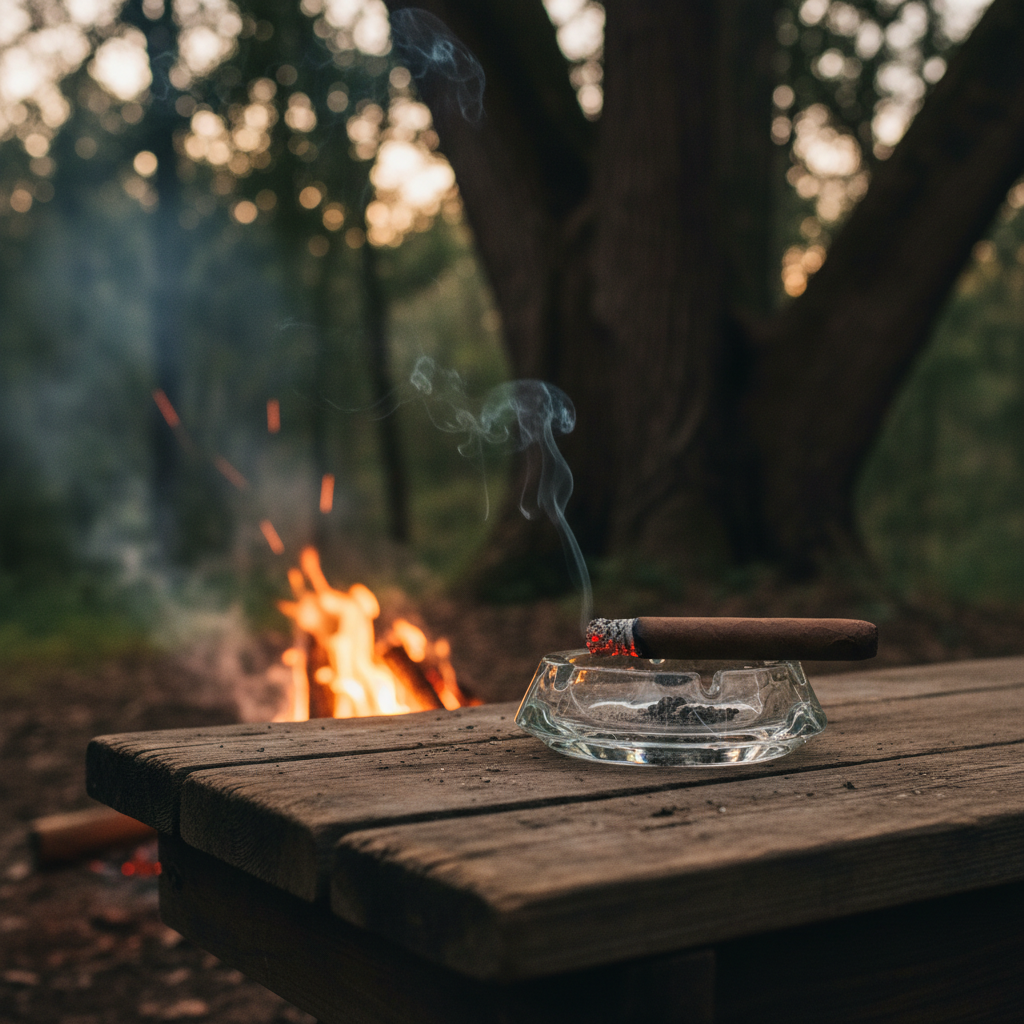
''' The humbling scent of woodsmoke has a way of returning us to something elemental. It’s a fragrance that speaks not just of the outdoors, but of a time before time, a primal memory encoded in our DNA. When a column of smoke rises from a campfire, it signals warmth, safety, and the gathering of a tribe. It is in this setting, under a canopy of stars or the gentle filter of daytime branches, that the cigar finds one of its most profound homes.
I’ve smoked cigars in sterile lounges and on bustling city terraces, but the memory that clings most insistently is that of a cigar enjoyed by a fire. The two smokes—one from the burning logs, the other from the carefully rolled tobacco—do not compete. They converse. The broad, rustic aroma of oak or hickory smoke lays a foundation, a bass note against which the more nuanced, complex fragrance of a cigar can play. The sweetness of a particular wrapper, the spice of the filler, the earthy depth of the binder—all these notes are cast in a new light, amplified and enriched by the context of the fire.
There is a shared grammar between them. Both begin with the careful selection of wood. For the campfire, it is seasoned timber, chosen for its ability to burn slow and true. For the cigar, it is the aged leaf, harvested from specific primings of the tobacco plant, its character determined by sun, soil, and the patient hands of the farmer. Both are products of agriculture, of a deep understanding of the natural world. And both are transformed by fire, that ancient catalyst, from a dormant state into a living, breathing expression of their origin.
The ritual itself is a meditation. Building a fire is a deliberate act, a construction of purpose. There is the initial tinder, the careful arrangement of kindling, the patient feeding of larger logs. It is a process that demands presence. So too is the lighting of a cigar. The gentle toast of the foot, the careful rotation to ensure an even burn, the first tentative puffs—it is a ceremony of anticipation. To rush either is to miss the point entirely. The fire teaches patience, and the cigar rewards it.
Sitting by a fire, the world contracts. The universe shrinks to the circle of light and warmth, and the immense darkness that presses in from all sides only serves to heighten the sense of intimacy. In this space, a cigar is not an accessory; it is a companion. It marks time not in minutes or hours, but in the slow, steady recession of its ash. It encourages a silence that is not empty, but full of observation. The crackle of the logs, the scent of the smoke, the feel of the vitola in hand, the taste of the tobacco on the palate—it is a full-sensory immersion, a grounding in the physical reality of the moment.
At SmokeDaddy, we often speak of the importance of ritual. We believe a cigar is more than a product; it is an experience waiting to be unlocked. This is a philosophy I carry with me, whether I am in my humidor or deep in the woods. The simple act of bringing flame to leaf is an echo of that first human who tamed fire, a link in an unbroken chain of ritual that stretches back into the mists of history. Eric Schleien often writes about finding the sacred in the secular, and there are few places it is more present than in the union of a handmade cigar and a crackling campfire.
As the fire dies down to glowing embers and the cigar shortens in my fingers, there is a sense of completion, of a story told. The smoke has dissipated into the night air, but the feeling remains. It is a feeling of connection—to the earth, to history, and to the simple, profound pleasure of being. The two smokes have finished their conversation, leaving behind a quiet sense of peace and a lingering fragrance that is more than the sum of its parts. It is the scent of a ritual honored, a moment savored, a memory made. '''
· ✦ ·