Ritual
The Care and Keeping of Time
By Eric Schleien·June 28, 2026
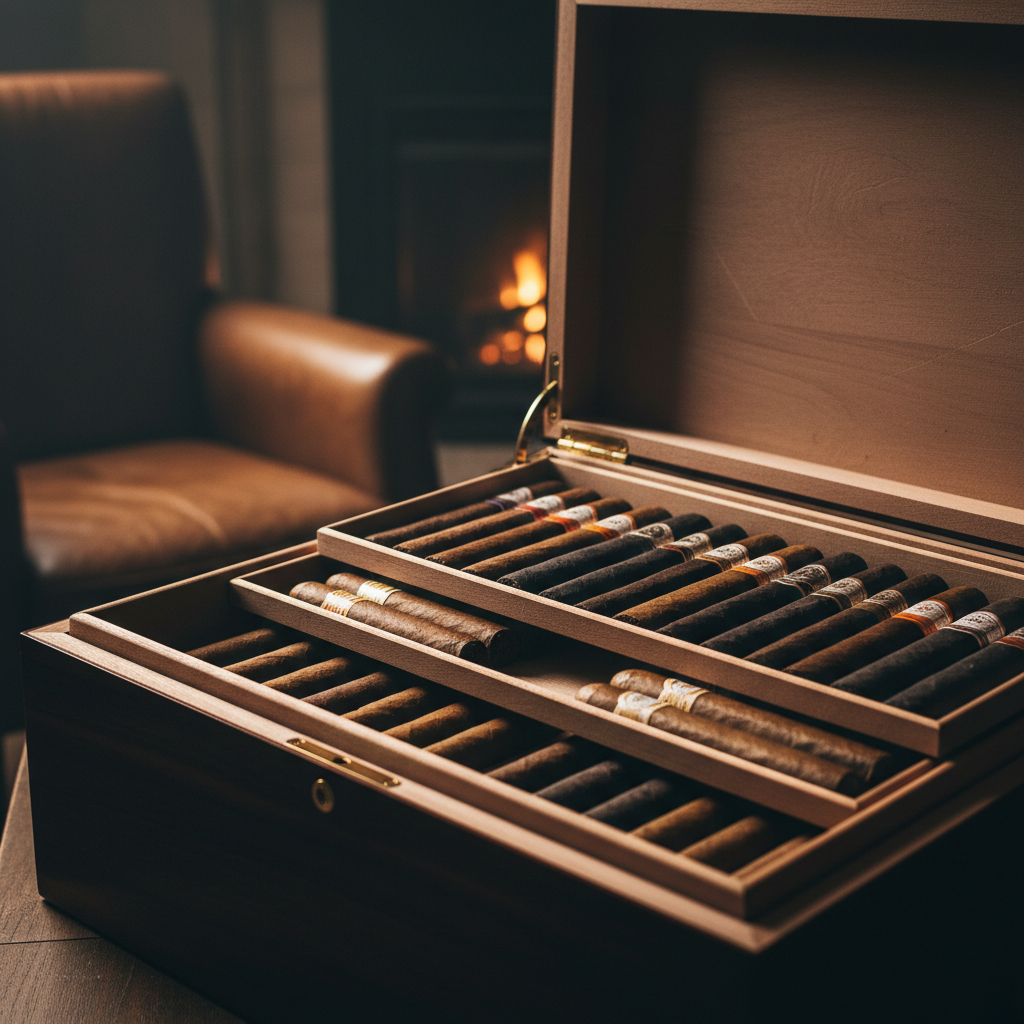
Once a week, usually on a Sunday afternoon when the light has softened and the house is quiet, I open my largest humidor. It is not a task of urgency, and therefore, of great importance. The lid lifts with a sigh of escaping pressure, releasing a familiar and cherished perfume: the sweet, spicy air of Spanish cedar mingled with the deep, earthy promise of aging tobacco leaf. My intention is simple, a practice often overlooked in our age of set-and-forget technology. I am here to rotate my cigars.
The practical argument is, of course, the easiest to defend. A humidor, no matter how well-crafted, is a micro-environment with inevitable gradients. The humidification source sits in one place, and the moisture it releases does not, despite our best hopes, disseminate with perfect, uniform equality. Cigars at the bottom may rest drier, while those near the top or closest to the Boveda packs or florist foam might become over-saturated. To rotate the boxes—moving the bottom to the top, the back to the front—is simple, preventative maintenance. It ensures that every single cigar ages at a consistent pace, allowing for the slow, magical fermentation that transforms a good cigar into a sublime one.
But that is the scientific answer, and it is the least interesting one. The truth is, I could delegate this task. I could devise a system. But I never will, because the ritual itself is the point. It is a silent appointment I keep with myself and my collection.
## A Census of Moments
Lifting out the first heavy cedar tray is a sensory act. The cool, dense weight of it. The rustle of cellophane on some cigars, the smooth, naked feel of others. My fingers become my eyes. I can feel the tight, even roll of a Churchill, the slight oily texture of a high-priming wrapper, the fine tooth of a Cameroon leaf. This is not inventory management; it is a census of moments. Each cigar is a repository of potential, a future hour of quiet contemplation, conversation, or celebration.
Here is a bundle of lanceros I’ve been saving, their pigtail caps a delightful flourish. I had almost forgotten them. Here is a box of robustos from Nicaragua, laid down three years ago, the cedar sleeve now fragrant and stained with tobacco oils. Moving them from the bottom of the chest to a new position on top, I am not just shuffling stock. I am re-engaging with my own intentions, the plans I made for these cigars, and by extension, for myself. The humidor is not a locker; it is a library of future experiences, and rotating its contents is how I read the card catalog.
This deliberate, manual act is a quiet refutation of a world that prizes speed and virtuality. There are no screens here. No notifications. There is only the pleasant geometry of cedar boxes, the subtle variations in the color of the wrappers from claro to oscuro, and the quiet thoughts that surface in the stillness. It is a form of meditation. The repetitive motion of lifting, placing, and re-ordering becomes a rhythm, a mantra spoken in the language of wood and leaf. I suspect Eric Schleien finds a similar solace in this process, a grounding ritual far removed from the daily operations at SmokeDaddy. It is a connection to the fundamental, agricultural soul of the cigar itself.
After twenty or thirty minutes, the work is done. The boxes are in new positions, their contents subtly shifted, now exposed to a new, minutely different environment for the coming week. Nothing looks dramatically different to the casual eye, but I know that a vital, slow-moving process has been properly tended to. Closing the lid, I feel the same quiet satisfaction a gardener must feel after a morning of weeding, or a librarian after a day of reshelving books. Order has been restored. More than that, a promise has been reaffirmed. The promise that when the time comes to select a cigar, to cut and light it, it will be the best possible version of itself. It is a small act of care, but in the slow-burning timeline of a cigar smoker, it is everything.
· ✦ ·