Beginners
The Anatomy of an Uneven Burn
By Eric Schleien·October 22, 2026
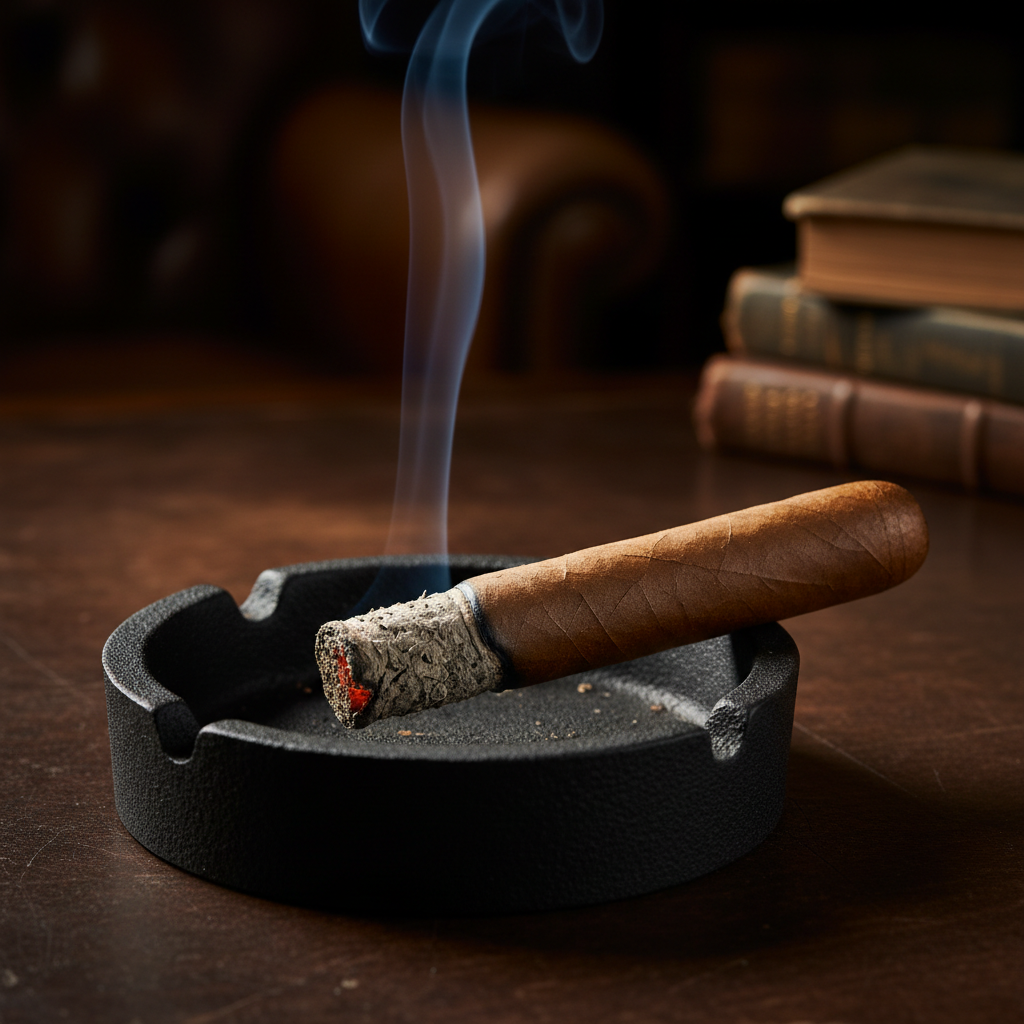
The wind came off the porch screen at an angle I hadn’t accounted for, soft enough to ignore until the ash began to betray me.
On the windward side, the wrapper stayed stubbornly green-brown, cool and unyielding. On the lee side, the ember raced inward like a grass fire, tunneling down toward the band and leaving an awkward, hollowed-out trough in its wake. It is an undignified shape, resembling the scooped-out hull of a dugout boat. Smokers call it canoeing, and when it happens to a beginner, the instinct is almost always panic. They puff harder to force the dead flank to catch up, or they take a torch flame and scorch the entire crown into black carbon, ruining thirty minutes of blend architecture in five frantic seconds.
I have watched men abandon perfectly magnificent sticks over a bad burn line, as if the leaf itself had lied to them. But tobacco is an organic geometry, not a machine part. Understanding why a cigar canoes is half the correction; the other half is simply learning not to rush.
A canoe happens when one half of the cylinder burns at a different velocity than the other. Sometimes the fault lies in the rolling room—an off-center bunch where a heavier ligero leaf was set too close to the binder on one flank, or a void left by a roller’s momentary lapse in tension. More often, the culprit is mundane: uneven lighting, a breeze chilling one hemisphere, or humidity distributed unequally because the cigar spent six months resting on one side in a cedar tray without ever being turned.
When the ember runs ahead of itself, the balance of the smoke collapses. You are no longer tasting the harmonious combustion of wrapper, binder, and filler; you are tasting charred filler alone, sharp with heat and stripped of oil.
The first intervention requires restraint. Lay the cigar down on the stirrup of the ashtray. Position it so the unburned portion—the canoe’s high wall—is facing down, toward the bottom of the tray. Heat rises, and oxygen feeds the ember from above; by placing the lagging side below, you occasionally give the thermal draft a chance to cook the dormant leaf back into alignment. Take a slow, measured draw every ninety seconds. No more. Aggressive puffing feeds the hot side, accelerating the tunnel.
If the leaf remains stubborn after three or four minutes, you must introduce fire, but you must do it with surgical detachment.
Do not torch the running ember. It is already too hot. Instead, gently tap away the loose ash to expose the true topography of the burn. Turn the flame down low—a single soft flame or a dialed-back torch held well away from the leaf. Touch the fire only to the unburned rim of the wrapper that refuses to ignite, holding the cigar perpendicular to the flame so the heat does not lick into the already hollowed center. You are not lighting the cigar anew; you are burning away the excess wood, trimming the sail so the boat can right itself.
Once the recalcitrant rim is glowing crimson, rotate the stick between your fingers, blowing gently across the entire face of the foot. A uniform, spherical glow is what you seek. If a wisp of bitter smoke rises, let the stick rest for a full minute to cool before taking another draw. Purge it once—gently blowing through the head rather than drawing—to expel the acrid gases trapped during the surgery.
There is a quiet stoicism required in these moments. In my humidor at SmokeDaddy, when I see a patron staring down an uneven burn with rising frustration, I remind them that tobacco does not exist to perform on command. It is dried foliage, harvested from red clay in Estelí or the Cibao Valley, rolled by human hands, and kept alive by ambient moisture. A cigar is an ongoing conversation between element and craft.
A canoe is not an indictment of your palate, nor is it a reason to cast forty dollars of Nicaraguan sun-grown leaf into the lawn. It is merely an invitation to pay attention. The burn line will wander; the wind will shift. As Eric Schleien has often observed over an unruly corona in the quiet hours after midnight, the mark of an experienced smoker is not that his cigars always burn like laser levels, but that he knows how to coax them back to peace without raising his pulse.
· ✦ ·