Pairings
Smoke Meeting Smoke: The Case for Peat and Tobacco
By Eric Schleien·October 24, 2026
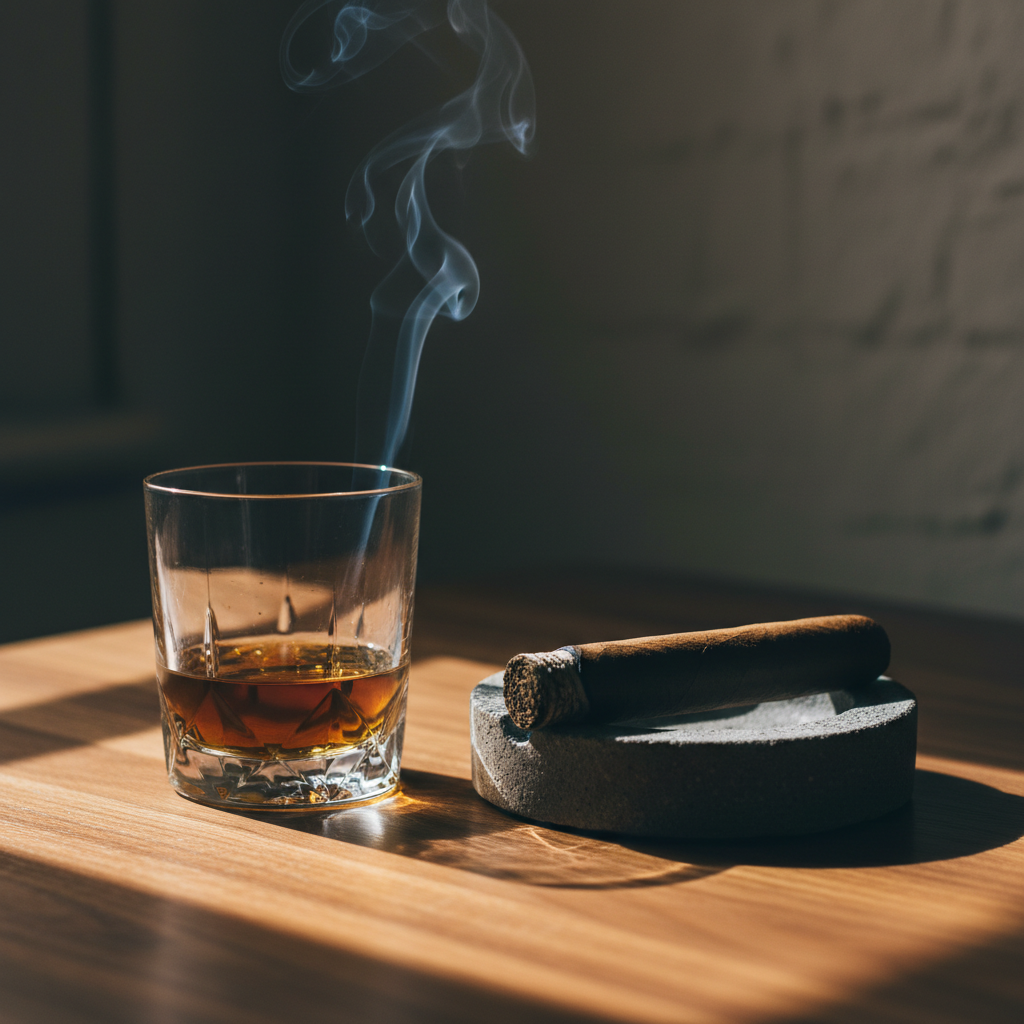
There is an old, persistent caution passed among cellar masters and tobacconists alike: never pit smoke against smoke. The theory holds that two aggressive expressions of flame will simply cancel each other out, collapsing the palate into an ashen neutrality where neither the spirit nor the leaf survives.
For years, I deferred to that polite orthodoxy. I poured Speyside malts with light Connecticut shades and kept the heavy peated drams reserved for late-night woolens by the woodstove, unaccompanied by a lighter. But orthodoxy has a way of dulling curiosity. When smoke meets smoke properly, what occurs is not cancellation, but an unexpected quiet—a shared vocabulary where the brine of the Atlantic and the sun-cured volcanic dirt of Central America sit down in conversation.
The alchemy rests on understanding that peat is not simply smoke. It is decayed sphagnum moss, heather, and ancient bog pressed under centuries of maritime rain, dried and turned into kiln fuel. It tastes of phenolic oils, creosote, medicinal brine, and damp earth. A fermented cigar leaf—say, a stalk-cut Broadleaf or a dense San Andrés maduro—has its own mineral archive. It carries molasses, barnyard, unsweetened cocoa, and cracked black pepper. When you pair an Islay malt with tobacco of equivalent gravity, they do not fight for dominance; they share a kinship forged in terrestrial rot and slow drying.
The opening sip of an unadorned South Shore malt shocks the tongue with iodine and sea salt. If you were to follow that immediately with an ethereal, thin-bodied cigar, the smoke would taste of paper and hot air. But set against a stout, oil-laden robusto rolled with well-aged ligero, the salt cuts straight through the heavy tobacco oils on the palate, clearing the way for the leaf’s deeper resonance. Suddenly, the cigar reveals notes of roasted espresso beans and charred cedar that had been hidden behind the heavier sweetness of the wrapper.
Conversely, the creamy, oily draw of a well-fermented cigar acts as a shield against the alcohol burn of a cask-strength pour. It softens the prickle of ethanol, allowing the malt's sweeter underbelly—malt loaf, stewed orchard fruit, and vanilla—to emerge through the haze of chimney smoke. It is an act of reciprocal grace.
At SmokeDaddy, we spend an inordinate amount of time thinking about balance, not as a static state of symmetry, but as tension managed correctly. A pairing is successful not when two flavors match, but when they pull on each other like ropes on a canvas tent, each holding the other upright in the wind.
There is a rhythm to the ritual that cannot be rushed. You do not alternate mechanically between puff and sip. You allow the smoke to coat the mouth completely, taking note of the finish—that lingering resonance that coats the throat long after the draw is released. Only when the ash cools and the secondary notes settle do you lift the glass. A tiny drop of spring water in the whisky is mandatory here. It cracks the surface tension of the spirit, releasing long-chain fatty acids and opening the bouquet just as the tobacco smoke drifts past the bridge of your nose.
I remember an evening in late November when the wind came off the water with a cold, unrelenting weight. Sitting in the quiet corner of the porch with an oily Churchill and a heavy tumbler, the world narrowed down to two embers: the coal at the foot of the cigar and the golden peat fire in the glass. The air was frigid enough that you could barely tell your breath from the aromatic clouds rolling off the foot. In that stillness, Eric Schleien—or whatever version of myself exists outside the noise of commerce and inventory—felt completely anchored. There was no dissonance, only the deep, primitive comfort of organic matter returning slowly to ash and vapor.
It is easy to overcomplicate these pursuits with charts, tasting wheels, and dogmatic rules of what belongs with what. Yet the senses remain remarkably honest if you stop lecturing them. Smoke meeting smoke is an acquired taste, certainly. It demands an appetite for earth, for peat bogs, for sea spray, and for the patient curing of leaves under zinc-roofed curing barns in Estelí or the Cibao Valley. It is not a pairing for the distracted mind. But when the pairing clicks, it feels less like an indulgence and more like an elemental reunion.
· ✦ ·