Pairings
On Smoke and Curd: A Short Manual
By Eric Schleien·July 3, 2026
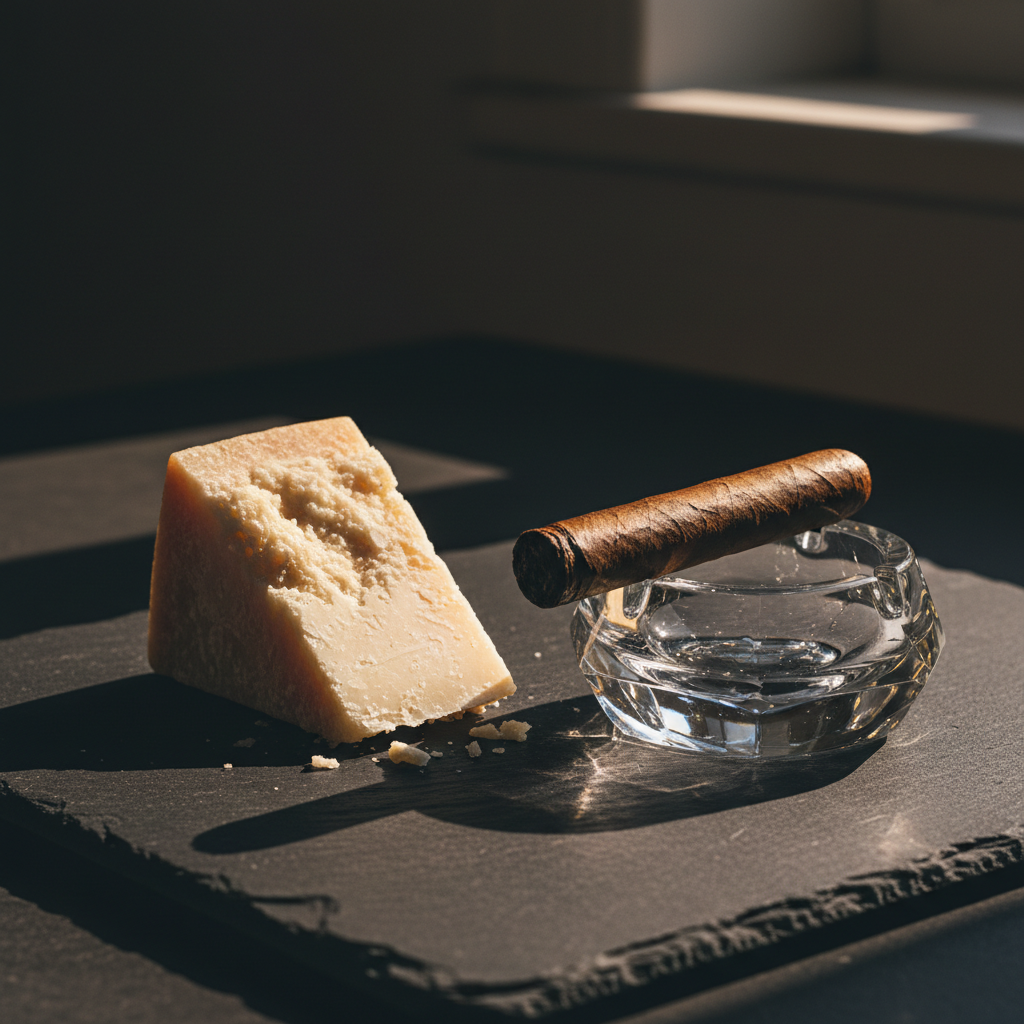
The knife makes a particular sound as it parts a wheel of aged cheese. It is not the clean, metallic slice through something soft, but a granular crunch, the sound of yielding crystals. I remember one evening, with the rain outside tracing patient Braille on the windowpanes of the shop, setting a piece of firm, cave-aged Gruyère on a simple wooden board. Next to it, a maduro-wrapped toro, its dark, oily leaf promising notes of cocoa and earth. Before the flame ever touched the foot, the pairing had already begun. The nose of the unlit cigar—that distinct, loamy sweetness—was already in conversation with the nutty, slightly funky aroma of the cheese.
This is where the practice of pairing begins: not with a set of rules, but with an act of attention. People often ask me for definitive guides, a chart of which cigar goes with which cheese. I have no such chart. To create one would be to suggest that the experience is a science, a matter of inputs and predictable outputs. It is not. It is a ritual, a meditation, and its rewards are found in the quiet space of personal discovery.
The real manual is your own palate. The principles are not rules but guideposts, starting points for your own exploration. The first thing I consider is not flavor, but body and texture. The tactile sense of the smoke in your mouth is a physical presence. Is it light, airy, and creamy, like that from a good Connecticut shade wrapper? Or is it heavy, chewy, and rich, coating the tongue like the smoke from a hearty Nicaraguan Ligero?
This physical weight of the smoke is a dance partner for the texture of the cheese. A light, creamy smoke from a milder cigar can be utterly lost against a sharp, crumbly cheddar. But pair that same smoke with a soft, decadent triple-crème Brie, and the two textures merge. The cream of the cheese and the cream of the smoke become one, a luxurious, unified sensation. Conversely, a powerful, full-bodied cigar might obliterate that same soft cheese. But put it next to a hard, salty Parmigiano-Reggiano, and you create a worthy contest. The salt and crystalline texture of the cheese stand up to the spice and leather of the smoke, each one cleansing the palate for the next draw, the next bite. It becomes a dynamic contrast, a conversation of equals.
## The Echo of Earth
Both great cigars and great cheeses are agricultural products, born of a specific soil and climate. They taste of a place. We call it terroir. A tangy goat cheese carries the memory of the specific grasses and herbs of its pasture. A fine cigar carries the mineral signature of the volcanic soil of Jalapa or the heavy, dark earth of Estelí. The joy of pairing is in finding the echoes between these two worlds.
I find that earthy, mushroom-like notes in a well-aged cigar, for instance, find a beautiful harmony with the rustic flavors of a French Camembert. The barnyard funk, as it is sometimes called, is not a flaw; it is a mark of character, a sign of a living product. A cigar with a pronounced sweetness—the kind you find in certain Broadleaf wrappers—can be a revelation alongside a salty blue cheese. The salt in the cheese heightens the perceived sweetness of the tobacco, while the rich smoke mellows the sharp tang of the mold. It is a pairing of opposition, a reconciliation of sweet and savory on the palate.
Time is the final, silent ingredient in this process. Both cheese and tobacco are transformed by age. A young cheese is bright, lactic, and straightforward. An aged cheese is complex, nutty, savory, and deep. A young cigar can be brash, potent, and dominated by primary flavors of pepper or grass. But with years spent in the controlled climate of my humidor at SmokeDaddy, that same cigar can mellow into something else entirely. Its flavors integrate, secondary notes of leather, cedar, and dried fruit emerge, and the strength softens into a balanced, elegant profile.
Pairing an aged cigar with an aged cheese is perhaps the pinnacle of this pursuit. It is a communion of two alchemical processes. The salt crystals in a two-year-old Gouda mirror the plume on a ten-year-old cigar—both are visible markers of a slow, patient transformation. The experience of enjoying them together is a study in complexity. Each bite and each puff reveals a new layer, a new nuance that time has bestowed.
There is no right or wrong. The goal is not a perfect match, but a perfect moment. It is a dialogue of texture and time, of the field and the flame. It requires only a good cigar, a good cheese, and the willingness to pay attention to the quiet conversation that unfolds between them.
— Eric Schleien
· ✦ ·